
Why Discipline Feels Impossible on Winning Streaks
Nobody blows up during a drawdown thinking they're making smart decisions. But I've watched traders, technically competent, rule-following, disciplined traders, crater their accounts during the best runs of their trading careers. That's the part of trading psychology nobody talks about. The grief counseling always comes after the losses. The silence surrounds the wins.
Key Takeaway: Winning streaks don't just boost your confidence, they trigger a biological dopamine loop that makes rule-bending feel like evolution and sabotage feel like skill. The discipline collapse during hot streaks can be more dangerous than the tilt that follows losses, because it's invisible until the account statement arrives.
The Myth That's Killing More Accounts Than Any Drawdown
Myth: Discipline problems are a loss-recovery issue. The dangerous moment in trading is after a string of red trades, when emotion takes over and you start revenge trading.
Reality: After a loss, most traders are on guard. They know they're vulnerable. They slow down, check their rules, maybe step away from the platform. The psychological defenses go up.
What I Actually See: The real carnage happens five, six, seven trades into a hot streak. The trader who was meticulously following their ICT checklist on trade one is now, by trade seven, entering off a 1-minute FVG they spotted on a whim, sizing up because "the setup feels strong," and moving their stop because "this one's different." They're not in panic mode. They're in euphoria mode. And euphoria is a far more dangerous state to trade from, because it feels like mastery.
After more than a decade trading ICT concepts, the blow-ups that surprise me most tend to happen during the runs that look, from the outside, like a trader finally breaking through.
What Your Brain Is Actually Doing During a Hot Streak
Here's what most trading psychology content glosses over: winning doesn't just feel good, it chemically reorganizes your decision-making. Each profitable trade releases dopamine, the same neurotransmitter involved in every compulsive behavior humans struggle to regulate. And crucially, dopamine isn't just a reward signal. It's an anticipation signal. It trains your brain to expect the next hit.
A few trades into a winning streak, the part of you responsible for rule-following and delayed gratification is up against a part that's now convinced MORE action equals MORE reward. Your own brain starts lobbying against your trading plan.
The dangerous part? It doesn't feel like recklessness. It feels like confidence. It feels like you've finally figured something out. You start to believe the rules that constrained you before are training wheels you no longer need. This is why so many traders get into trouble on funded account challenges right after a clean early run.
In my experience, overconfidence does more damage to accounts than fear does. Investopedia's overview of overconfidence bias is a decent primer on the idea. The problem is that overconfidence doesn't announce itself. It disguises itself as competence.
A Worked Example
I used to get this wrong too. Here's the kind of trade I mean.
Picture a trader on a clean run of wins on GBPUSD, mostly 15-minute setups during the London open. Clean BOS entries, consistent risk, partials at logical draw levels. Everything by the book.
Then a compelling-looking Fair Value Gap forms on the 5-minute after a minor displacement move, but the higher timeframe context is murky. The daily is sitting mid-range between two significant liquidity pools, not clearly in discount, with no confirmed MSS. On a normal day this is a skip. That's what a checklist is for, and you can see the full FVG checklist breakdown here.
But they're deep into a run. The stop ends up wider than their standard, and the size ends up bigger than usual because "conviction is high." As if a string of unrelated prior setups somehow proved this one valid.
The problem is where the stop sits. With no clean swing or liquidity sweep behind the entry, the stop is just below a level where obvious sell-side liquidity is resting. Price runs that liquidity, takes the stop, then reverses in the original direction. A classic liquidity grab they would have spotted instantly on a clear-headed day. One oversized trade gives back a big chunk of the run. The market did nothing unusual. The checklist had just been quietly retired.
The Archetype I See Blow Up During Bull Runs
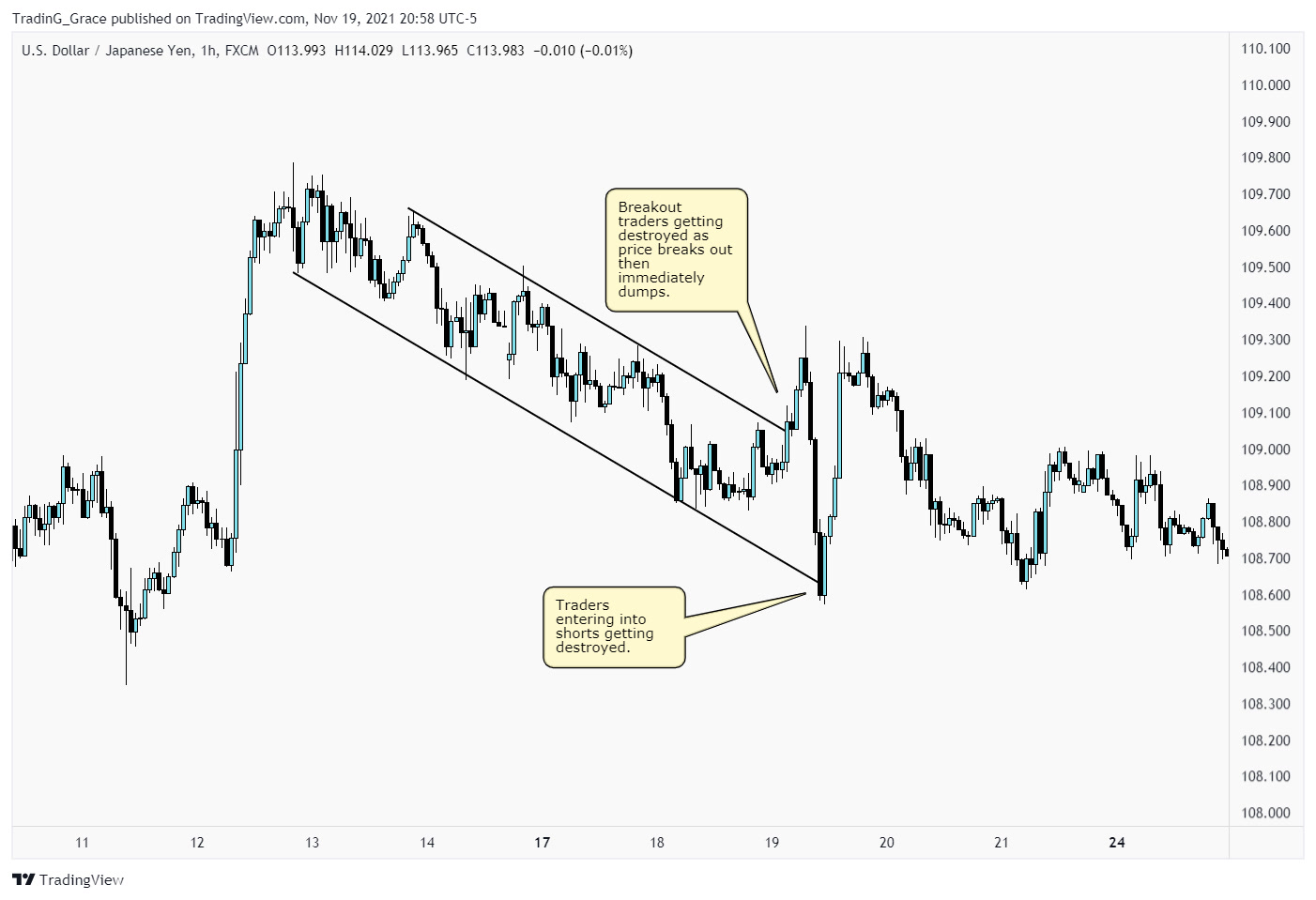
There's a specific trader pattern that shows up reliably in forums and trading communities after a good week: the person who was cautious and methodical through their first five or six wins, then posts something like "starting to trade more by feel" or "loosening up my rules since they were holding me back."
That phrasing, holding me back, is the tell. The rules weren't holding them back. The rules were the mechanism that produced the wins. But after enough reinforcement, the brain reframes constraints as limitations rather than structure. The trader isn't stupid; they're neurologically compromised by their own success.
This specific pattern tends to show up several trades into a streak. By that point, the position sizing has usually crept up, the timeframe has dropped (more 1-minute and 3-minute "confirmations" appearing in their charts), and the stop placement has gotten either too tight, chasing perfection, or too wide, accommodating a trade they wanted rather than one they found. Both are failure modes. Both stem from the same source: a brain that has stopped processing risk accurately because reward has been too consistent.
If you want to understand how this connects to why Q2 2026 market structure is punishing traders who've gotten comfortable, it's the same mechanism, the market adapted, but the trader's dopamine-adjusted brain kept expecting last quarter's conditions to repeat.
The Hot Streak Protocol: A Practical Framework
This isn't theory. This is what I actually implement, and what I'd tell any serious trader to build into their process before they need it.
Step 1: Define your streak threshold in advance. Before you start a trading week, write this down: "If I close [X] consecutive winning trades, the following rules activate." For most traders running 0.5-1% risk, X should be four or five. The number matters less than the fact that it's predetermined. You cannot set this rule after the streak starts, that's like writing your drinking limit after the third drink.
Step 2: Mandatory checklist review after every third winning trade. Not a casual glance. A full written review of the last three trades: Was entry in discount? Was HTF narrative aligned? Did you wait for a confirmed MSS or jump early? Did the trade meet all nine FVG criteria or just six? Pull up your risk calculator and verify position sizing was correct on each one. You're looking for drift, subtle places where you bent the rule but the trade won anyway, which your brain will remember as "the bent rule works."
Step 3: Reduce size on the trade immediately following a streak. Counter-intuitive, but critical. Drop to 0.25% risk on the first trade after any four-win run. Not because the setup is worse, but because your judgment is compromised and smaller size forces cleaner decision-making. If the trade wins at reduced size, that's confirmation. Scale back to normal the trade after that.
Step 4: Implement a mandatory session gap after five consecutive wins. Close the platform. Walk away for the rest of that session. This is the rule most traders resist because it feels like leaving money on the table. That resistance is the dopamine talking. Five wins in a session is a week-defining result. Protect it. The market will be there tomorrow.
Step 5: Journal specifically for overconfidence signals. After any winning trade, write one sentence answering this question: "What rule was hardest to follow on this trade, and did I follow it?" If you can't identify a moment of discipline, a point where you wanted to deviate but didn't, you probably weren't being disciplined. You were just in a trade that worked despite the absence of discipline. That distinction matters enormously for what comes next.
The Contrarian Truth About "Finding Your Edge"
Most ICT-adjacent content frames discipline as a prerequisite to finding your edge, like once you find the edge, discipline becomes easier. After ten-plus years of this, I'd flip that entirely: your edge doesn't make discipline easier. It makes discipline more necessary and harder to maintain.
Because once you have a genuinely working strategy, the wins come. And when the wins come, the dopamine comes. And when the dopamine comes, the checklist starts to feel optional. This is precisely why profitable traders blow up. Not because their edge failed, but because success created the neurological conditions for abandoning it.
The traders who last aren't the ones who feel most disciplined during losses. They're the ones who built systems to stay disciplined during wins. That's the real psychological edge, and it's the one almost nobody is training for.
If you're in Q2 2026 and you've had a strong start to the year, this is the exact moment to stress-test your process, not congratulate yourself out of vigilance. Check out the trading insights archive for more on building a system that holds up under both pressure and success.
The next step isn't complicated: go pull your last ten trades and count how many came during a winning streak. Then check whether your entries, sizing, or stop placement drifted even slightly on trades five through ten compared to trade one. If you see drift and the trades still won, that's not evidence your rules are wrong. That's a ticking clock. If you want to work through this systematically, the coaching options here are built specifically for traders who already have some skill but keep watching it evaporate at the wrong moments.
Harvest Wright
ICT Trading Coach · 10+ Years Experience
Harvest specializes in ICT methodology and has helped traders pass prop firm challenges, develop consistent strategies, and build the psychology needed for long-term profitability.
Book a Free Discovery Call →Ready to Get Funded?
1-on-1 ICT coaching built around prop firm rules, from a trader who has passed an FTMO Challenge.
Book a Free Discovery CallFree ICT Funded-Trader Playbook
The setups, the pre-trade checklist, and the risk rules I use. Get it free.