
Why Good Mentorship Feels Uncomfortable
There is a pattern I have watched repeat itself over and over across more than a decade of trading ICT concepts, and it is this: the trader who is closest to a real breakthrough is almost always the one who sends the message saying 'I don't think this is working for me.' If you have ever left an ICT trading mentor because the feedback felt wrong, or because you stopped feeling validated, or because you just couldn't shake the sense that something wasn't clicking, this article is specifically for you.
Key Takeaway: Discomfort inside a coaching relationship is not a signal of incompatibility. It is usually a signal that the dismantling process is working. Traders who consistently self-select out of relationships that are actually working are making a psychological mistake, not a strategic one.
Myth: A Good ICT Trading Mentor Should Feel Like Clarity From Day One
Myth: If a mentor is the right fit, things should start making sense quickly. You should feel seen, understood, and progressively more confident.
Reality: Good mentorship, in the early and middle stages, often feels like the opposite. It feels like someone is slowly removing the floor beneath your feet. Your entries start getting questioned. Your bias formation process gets pulled apart. The way you read market structure, which felt solid for years, suddenly has four holes in it you cannot unsee. That is not a sign the mentor is wrong for you. That is the sound of a belief system being upgraded.
What I Actually See: Traders arrive in mentorship situations with a deeply formed identity. 'I'm an order block trader.' 'I trade the Asian session.' 'I don't touch news days.' These aren't just strategies. They're load-bearing walls in how that person understands themselves as a trader. When a mentor challenges one of those walls, even gently, even with data and logic, the emotional response isn't 'interesting, let me update my model.' The emotional response is closer to threat detection. And the first instinct is to leave and find someone who confirms the existing model instead.
This is the trap. Comfortable mentorship almost always means the mentor is selling you a refined version of what you already believe. Uncomfortable mentorship means someone is actually doing the job.
The Dismantling Has to Come Before the Building
Here's something most ICT YouTube content will never tell you, because it doesn't make for good thumbnails: you cannot build a durable trading framework on top of a flawed one. You have to clear the ground first.
When I was years into trading ICT concepts and still grinding through inconsistency, the hardest feedback I received wasn't 'your entries are wrong.' It was 'your entire read of what the market is doing before you enter is wrong.' That hits differently. Because it's not a technical fix. It's an identity fix. And identity doesn't want to be fixed. It wants to be confirmed.
This is why the urge to quit a mentorship relationship often peaks around the 4-to-8 week mark. Not because the mentor has failed. Because the deconstruction phase is at its most intense, and the new framework hasn't clicked into place yet. The trader is in the gap between what they knew and what they're learning, and that gap feels like regression. It feels like paying money to get worse.
It isn't regression. It's the most important part of the process.
The Archetype: The Validation Shopper
There's a specific trader profile I see repeatedly. This person is genuinely intelligent, has put in real screen time, and can articulate ICT concepts clearly enough to teach them. But underneath all of that is a quiet and persistent need for external confirmation that they're on the right track.
This trader hops between mentors not because mentors keep failing them, but because mentors keep doing their job. The first mentor questioned their bias formation. Exit. The second mentor pointed out they were consistently entering in premium instead of waiting for discount. Exit. The third one pulled up a recent loss and showed, in detail, why the trade was flawed from the jump. Exit.
After three to five of these exits, this trader usually lands on a content creator who delivers highly produced breakdowns that never challenge anything. The charts always look clean in hindsight. The concepts are correct but abstract. Nothing is ever applied to this trader's actual behavior. And the trader feels, finally, like they've found the right fit.
They haven't found the right fit. They've found a mirror.
The brutal truth is that validation shopping is one of the most expensive habits a developing ICT trader can build. Because every time you leave the relationship that's actually working and replace it with one that feels good, you reset the clock.
What Real Discomfort Actually Looks Like in Practice
Let me make this concrete, because 'discomfort is good' is meaningless without specifics.
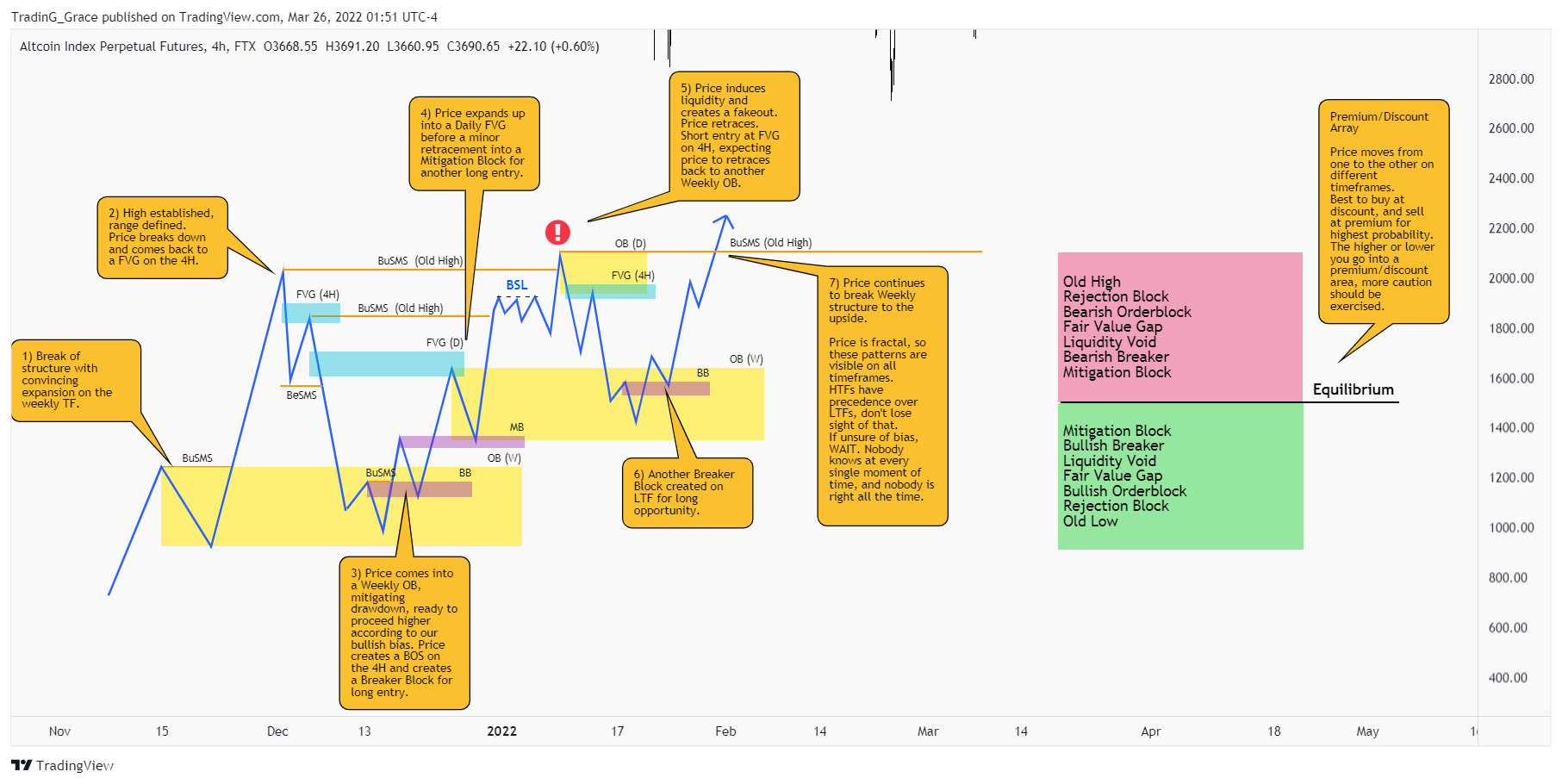
Picture EURUSD during the London open. Price has swept an Asian high, the 15-minute chart shows a clear break of structure to the downside, and on the 5-minute you have a fair value gap sitting just below the prior swing high. A trader sees this, enters short at the FVG, puts their stop above the Asian high, and targets the New York low from the previous session.
On paper, this looks like a competent ICT setup. Entry at a point of interest, stop above a liquidity pool, target at a logical draw. This is the kind of setup breakdown you'd find in the FVG checklist we broke down here.
But here's where a real mentor earns their weight: they ask whether price is currently in premium or discount relative to the range. They ask whether the 15-minute FVG the trader is entering at sits inside a higher-timeframe demand zone or above it. They ask whether the draw on liquidity below is the actual target or just an intermediate level with a larger inefficiency beneath it.
None of those questions feel good in the moment. They feel like the mentor is making something simple complicated. But each of those questions, applied consistently over months, is what separates a trader who occasionally catches a clean move from one who understands why price does what it does.
The discomfort of being interrogated about your setup logic, every time, is not a mentorship failure. It is the methodology being installed at depth, not just at surface level.
A Framework for Knowing the Difference
To be clear: not all discomfort is productive. There is a difference between a mentor who challenges your thinking and one who is simply disorganized, unavailable, or teaching concepts they don't fully understand themselves. Here's how to tell the difference.
Productive discomfort sounds like:
- 'Walk me through why you drew that level there.'
- 'You entered at the FVG but price was in premium relative to the weekly range. Did you account for that?'
- 'Your stop placement is technically correct, but look at what happened to price 30 minutes before your entry. What does that tell you about where liquidity actually sat?'
These questions have a direction. They're pulling you toward precision and structure.
Unproductive discomfort sounds like:
- Vague criticism with no specific framework for improvement
- Contradictory instructions week to week with no explanation for the change
- A mentor who can't explain the reasoning behind their own feedback
If your discomfort is coming from the first category, stay. If it's coming from the second, that's a legitimate signal to reassess. The coaching plans at R2F are structured specifically to avoid the second category. Every piece of feedback connects back to a clear ICT principle, not personal preference.
For traders still early in the process, the crash course is worth going through before entering any mentorship relationship, because arriving with foundational fluency means the mentor can operate at a higher level from week one.
The Question Nobody Asks Before Quitting
Before you exit a coaching relationship, there is one question worth sitting with for at least 72 hours: 'Am I leaving because this isn't working, or am I leaving because this is working and it feels terrible?'
Those two experiences feel almost identical from the inside. Both produce frustration. Both produce the conviction that you'd be better off somewhere else. The difference is in the quality of the discomfort. One is chaos with no clear path forward. The other is structured pressure that's remodeling something real.
I used to get this wrong too. Early in my development with ICT concepts, I equated progress with feeling more confident. When feedback made me less confident, I interpreted that as regression. It took longer than I'd like to admit to understand that the phase where you feel least certain is often the phase where the most accurate learning is happening. The false certainty of a half-formed model is comfortable. Its collapse is not. But its collapse is necessary.
This same dynamic shows up in funded account prep. The traders who struggle most during their FTMO Challenge aren't usually the ones with the biggest technical gaps. They're the ones who can't tolerate the discomfort of being held to a hard standard after months of trading with no real consequence. That shift is supposed to feel difficult. There's a reason it's detailed in the breakdown of what kills funded account challenges.
The Real Reason Traders Leave Right Before the Breakthrough
Here's the most honest thing I can say about this: breakthroughs in ICT trading are almost never sudden. They're the result of a slow accumulation of corrections, most of which felt pointless or wrong when they were applied. The breakthrough moment is just when enough of those corrections have compounded that the model finally holds its own weight.
The trader who leaves at week six of eight is three corrections short of that moment. They'll restart with someone else, spend four weeks getting back to the same level of foundational challenge, and feel the same discomfort, and often leave again at the same point.
The cycle breaks when the trader decides to treat discomfort as data rather than as verdict. When the urge to leave becomes a reason to ask 'what specifically is uncomfortable, and what does that tell me about where my model is weak?' rather than 'how quickly can I find someone who confirms what I already think?'
That's a harder discipline than any entry rule I know.
If you're currently in that uncomfortable middle phase and want to talk through whether what you're experiencing is productive discomfort or a genuine mismatch, book a free discovery call and we'll work through it directly. There's no pitch involved. Sometimes the most useful thing is just an honest assessment of where you actually are.
The coaching tiers at R2F run from Lite at $150/week through to Full Mentorship at $5,000 for four months. The right tier depends on how deep into the deconstruction process you actually need to go. That's worth getting right before you commit to anything.
Harvest Wright
ICT Trading Coach · 10+ Years Experience
Harvest specializes in ICT methodology and has helped traders pass prop firm challenges, develop consistent strategies, and build the psychology needed for long-term profitability.
Book a Free Discovery Call →Master Your Trading Psychology
Psychology is a huge part of trading. Our coaching includes dedicated psychology sessions.
See Coaching PlansFree ICT Funded-Trader Playbook
The setups, the pre-trade checklist, and the risk rules I use. Get it free.