Why Coaching Won't Fix a Process Problem
Somewhere between blowing a funded account and opening a new browser tab, a decision gets made. The decision feels logical: I need guidance. I need someone who's done this. Within 48 hours, a trader is on a coach's sales page, credit card in hand, searching for an ICT trading coach who has the piece they've been missing. I've watched this pattern play out more times than I can count. And here's the uncomfortable truth: the piece is almost never missing. It's already there. What's broken is the machinery between seeing a setup and clicking the button.
Key Takeaway: Buying coaching before you have a repeatable decision-making process is like hiring a personal trainer before you own shoes. No coach, regardless of their credentials or ICT depth, can install that process for you. You have to build it yourself, and this article shows you exactly how.
The Myth of the Missing ICT Concept
Ask any struggling trader to explain order blocks, and they'll give you a decent answer. Ask them about fair value gaps, and they'll walk you through the imbalance. Liquidity, premium and discount, market structure shifts, they've got it, or at least they've absorbed enough of it to hold a conversation. What they can't tell you clearly is what happens in their head between spotting the setup and sizing into the position.
That gap is where accounts go to die, and no ICT trading coach in the world can fill it from the outside.
The myth is that conceptual knowledge is the bottleneck. It almost never is. The trader who keeps getting stopped out on order block entries and assumes they need a better coach to refine their OB identification is, in my experience, almost always entering in premium when they should be entering in discount, or sizing up on a first-touch when a second-touch confirmation was sitting right there if they'd had a checklist to slow them down. The concept isn't the problem. The execution sequence is.
If you want a deeper look at how fair value gap entries go wrong specifically, this ICT FVG pre-trade checklist breaks down nine confirmations most traders skip entirely.
Myth, Reality, and What I Actually See
Myth: I keep losing because I'm missing advanced ICT knowledge my coach will unlock.
Reality: Advanced ICT concepts only compound process problems. More tools, more confluences, more nuance, without a decision framework, they just give a disorganised mind more things to argue with itself about before clicking the wrong button anyway.
What I Actually See: A trader who blew their FTMO challenge, felt the sting of it, and made an emotional decision inside a 72-hour window that they dressed up as a logical one. The funded account failure becomes the justification: see, I need help. But if you pull apart what actually broke the account, it's rarely an incomplete understanding of market structure. It's one of three things: a position sized too large relative to the drawdown limit, a trade taken during a session or news window that the trader's own rules said to avoid, or a revenge entry after the first loss of the day. All three are process failures. A coach teaches you ICT. A process prevents those three things from happening.
For a full breakdown of what actually kills funded accounts, this article on 7 fatal mistakes in funded account challenges is worth reading before you consider paying anyone anything.
Here's the Kind of Setup I Mean
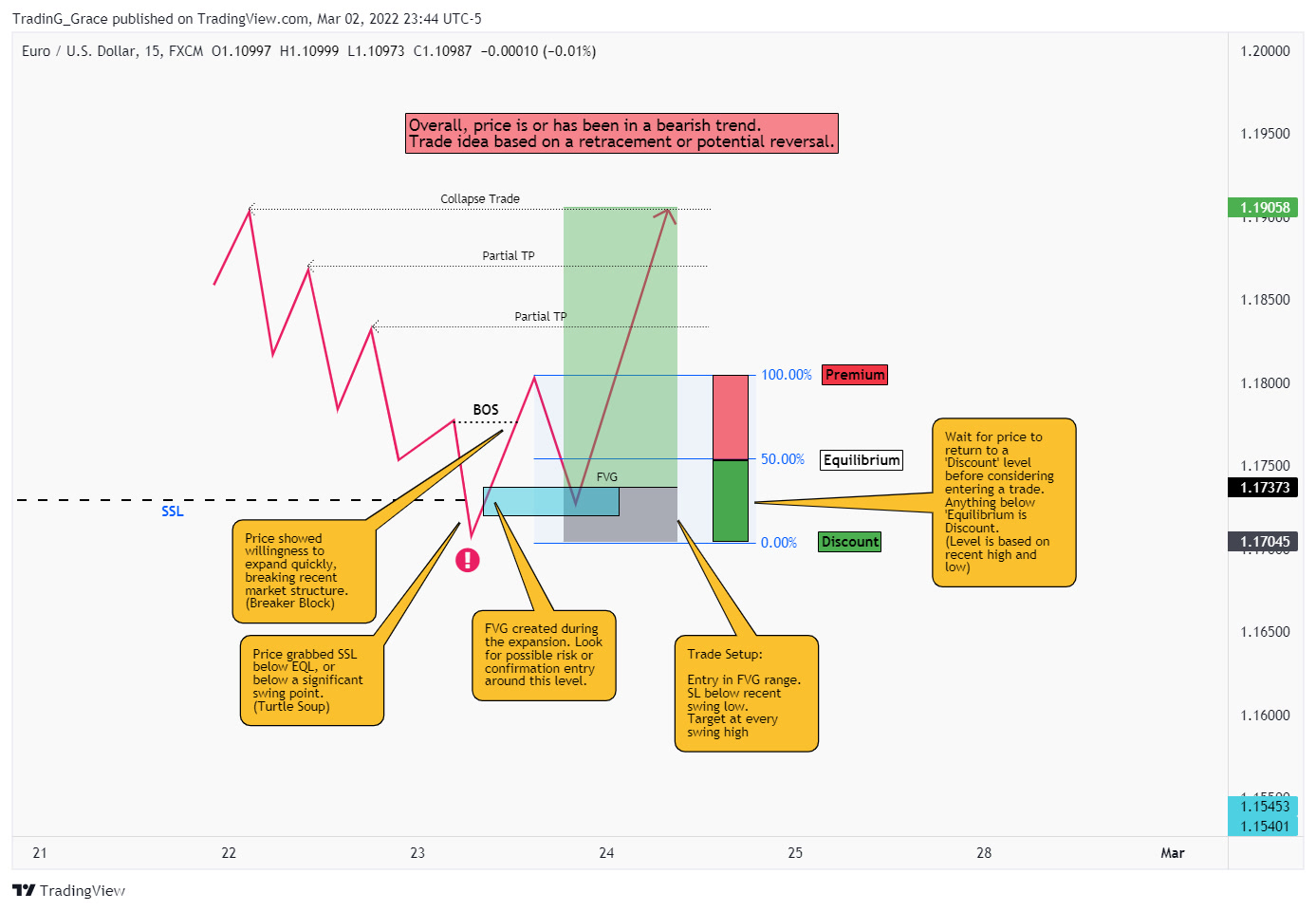
Picture EURUSD at the London open. On the daily, price has swept a prior week's low, taken the sell-side liquidity resting below a clean swing, and is now pushing back up into a 4-hour bearish order block that sits in premium relative to the most recent daily range. On the 15-minute chart, you can see a market structure shift to the upside, confirming the daily liquidity sweep. A fair value gap printed on that 15-minute leg, and price has since retraced into the upper portion of it.
That's a real setup. Every ICT trader reading this knows exactly what I'm describing.
Now here's the question: what do you actually do next?
Do you enter at the FVG midpoint? The top of the FVG? Do you wait for a 1-minute confirmation candle? Do you enter on a limit or a market? Where does the stop go, below the FVG, below the OB, or below the swept low? And critically: is price currently in premium or discount relative to the range you're working within?
If your answer to any of those questions is it depends without a specific rule that determines what it depends on, you don't have a process. You have an interpretation. And interpretations vary minute to minute based on how your last trade went.
For a setup like this, a clean decision framework would look like: entry on a limit at the 50% level of the 15-minute FVG, stop below the OB low with a buffer of about 10 pips to account for the spread and typical London stop-hunt noise, and a target at the next significant premium level or opposing liquidity pool on the 4-hour chart, which in this picture might be the prior day's high. The whole entry decision takes under 90 seconds. If any condition is unclear, no trade.
That's not advanced ICT knowledge. That's a process. And no one can hand it to you.
The Archetype I See Most Often in Q4 2026
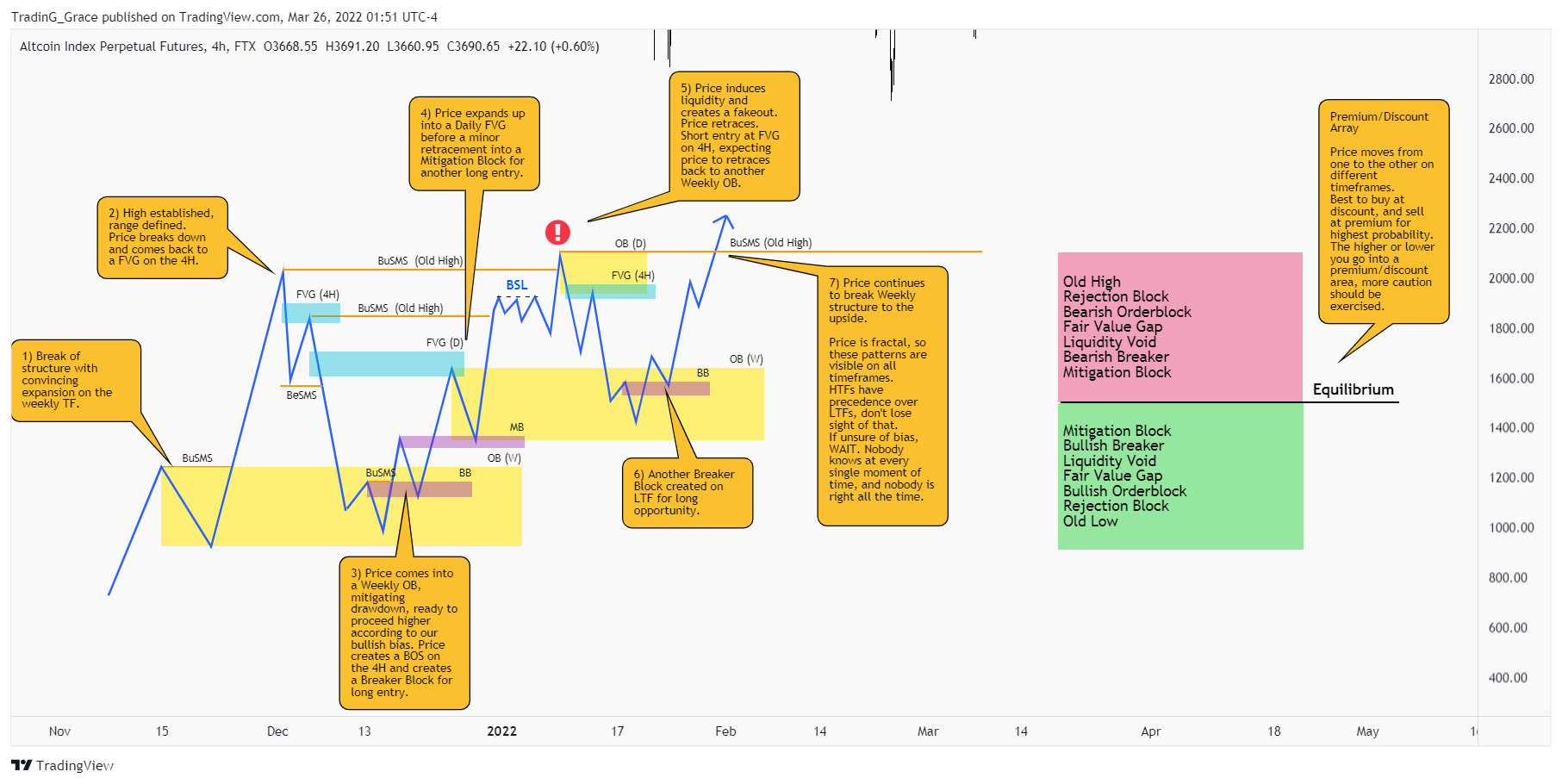
Here's a pattern worth naming: the trader who has genuinely solid ICT knowledge but treats every session like a new game. They have no pre-session routine. They open a chart and just... look at it. They find things. Sometimes they find a great setup. Sometimes they find a setup that sort of fits if you squint. The problem is that without a fixed starting point, a set of rules they check before any chart interaction, their perception of what counts as a valid setup is contaminated by whatever the last hour of price action looked like.
This trader often sounds very confident in Discord servers and in comment sections. They can explain ICT fluently. They cannot explain what their entry rules actually are in a way that another person could replicate independently. When they blow an account, they conclude the problem was their ICT knowledge. They hire a coach. The coach teaches them more ICT. The pattern continues.
I used to think this was a discipline issue. After years of looking at how traders actually fail, I've changed my mind. It's a systems design issue. Discipline is the exhaust, not the engine. If the engine, the decision sequence, is missing, no amount of coaching will make it appear.
The 90-Second Pre-Entry Loop (Build This Before You Buy Anything)
Here's a practical framework you can implement today. Before every trade entry, run through this loop in order. If you can't answer every question in under 90 seconds with a specific answer from your own written rules, you don't enter.
Step 1, Session and bias check. What session are you in? What is your higher timeframe bias for this session, and what specific condition would invalidate it?
Step 2, Premium or discount? Using the most recent high-to-low swing on your execution timeframe, is price currently in premium, at equilibrium, or in discount? Your rule should state which zones allow which trade directions.
Step 3, Setup identification. Name the specific model you're trading. Not "an OB with an FVG." The exact model: for example, "daily liquidity sweep, 15-minute MSS, 15-minute FVG entry in discount."
Step 4, Entry, stop, target. State your entry level (specific price or condition), your stop placement and the reason for it, and your target. Your risk calculator handles position sizing once you have these three numbers.
Step 5, Disqualifiers. Is there a news event in the next 30 minutes? Are you in a daily drawdown state that your rules say requires reduced size or no trading? Is this pair currently showing behaviour that fits a session you don't trade?
If all five steps pass, you enter. If one fails, you don't. That's it. It sounds basic because it is basic. That's the point. A process doesn't need to be sophisticated to work. It needs to be consistent and externally legible, meaning you could write it down and someone else could follow it.
This is what an ICT trading coach cannot give you, because a coach can only teach you the inputs. The sequence in which you apply them, the conditions you personally need to see before committing capital, the specific disqualifiers that fit your psychology and your account rules: those only come from iteration on your own trading history.
So When Does Coaching Actually Help?
Coaching has genuine value, but it's very specific value. It helps when you already have a process and that process has an identifiable hole. It helps when you're working through something like why your order blocks keep failing in ranging markets and you need a second perspective on whether your OB selection criteria are solid. It helps when you want accountability for following your existing rules rather than someone to write the rules for you.
At R2F Trading, our coaching plans start at $150 per week for Lite and go up to $250 per week for Pro, with a Full Mentorship option at $5,000 for four months. Those structures are designed for traders who already have skin in the game, a process they've tested, and a specific problem they're solving, not for traders who want the process handed to them ready-made.
If you're genuinely at the beginning and want to understand what a structured ICT foundation looks like before any coaching conversation, the crash course is a better starting point and a much smaller financial commitment.
The One Question That Tells You Everything
Before you search for an ICT trading coach, before you book a call, before you spend anything, ask yourself this: can you write down your entry rules specifically enough that a stranger could follow them and identify the exact same trade you would take?
If yes, coaching can help you sharpen what's already there. If no, the money you spend on a mentor will teach you more ICT concepts on top of a foundation that already has a crack in it.
Fix the crack first. Build the process. Then if there's still a gap, book a free discovery call and we'll figure out together whether coaching is actually what moves the needle for you, or whether there's a faster path to what you're trying to solve.
Harvest Wright
ICT Trading Coach · 10+ Years Experience
Harvest specializes in ICT methodology and has helped traders pass prop firm challenges, develop consistent strategies, and build the psychology needed for long-term profitability.
Book a Free Discovery Call →Ready to Get Funded?
Our students pass prop firm challenges in under 60 days with personalized ICT coaching.
Book a Free Discovery CallFree ICT Funded-Trader Playbook
The setups, the pre-trade checklist, and the risk rules I use. Get it free.