
Best ICT Trading Course: Hype vs. What Actually Works
After more than a decade of trading, working through ICT concepts, passing an FTMO Challenge, and watching traders at every level try to piece this methodology together from YouTube playlists and Discord servers, I have a strong opinion on the best ICT trading course question. And it probably isn't the answer you're expecting.
Most articles ranking for this keyword are comparison lists written by people who have never taken a trade using these concepts. They aggregate pricing tables, paste in YouTube thumbnails, and call it a review. This one is different.
Key Takeaway: The best ICT trading course is the one that teaches you how price delivery works, not just what the setups look like. If a course can't explain why a Fair Value Gap forms and what it means about institutional order flow, it's selling you a pattern-matching cheat sheet, not an edge.
The Core Problem With Most ICT Courses
Here's what I've observed over years of being neck-deep in this community: the most popular ICT content online is popular precisely because it oversimplifies. Short-form videos that show a clean FVG into a mitigation block with a perfect 5R result get thousands of likes. That's the feed-friendly version of this methodology.
The actual work is slower, messier, and far more contextual than any highlight reel suggests.
A course that's genuinely worth your money will force you into discomfort. It'll make you study draw on liquidity before it shows you an entry model. It'll explain why price seeks equal highs or equal lows before it ever hands you a setup. The shortcut courses skip that foundation entirely, which is exactly why traders who go through them keep failing the moment market conditions shift even slightly.
When conditions turn choppy and compressed, this problem is amplified, and traders who learned ICT as a rigid visual pattern system get wrecked. If you want to understand why, I wrote about it directly in why Q2 2026 market structure shifts are breaking traditional ICT setups and how to adapt.
A good course builds a framework that survives changing conditions. A bad one teaches you to spot shapes on a chart.
What a Real Edge Actually Looks Like
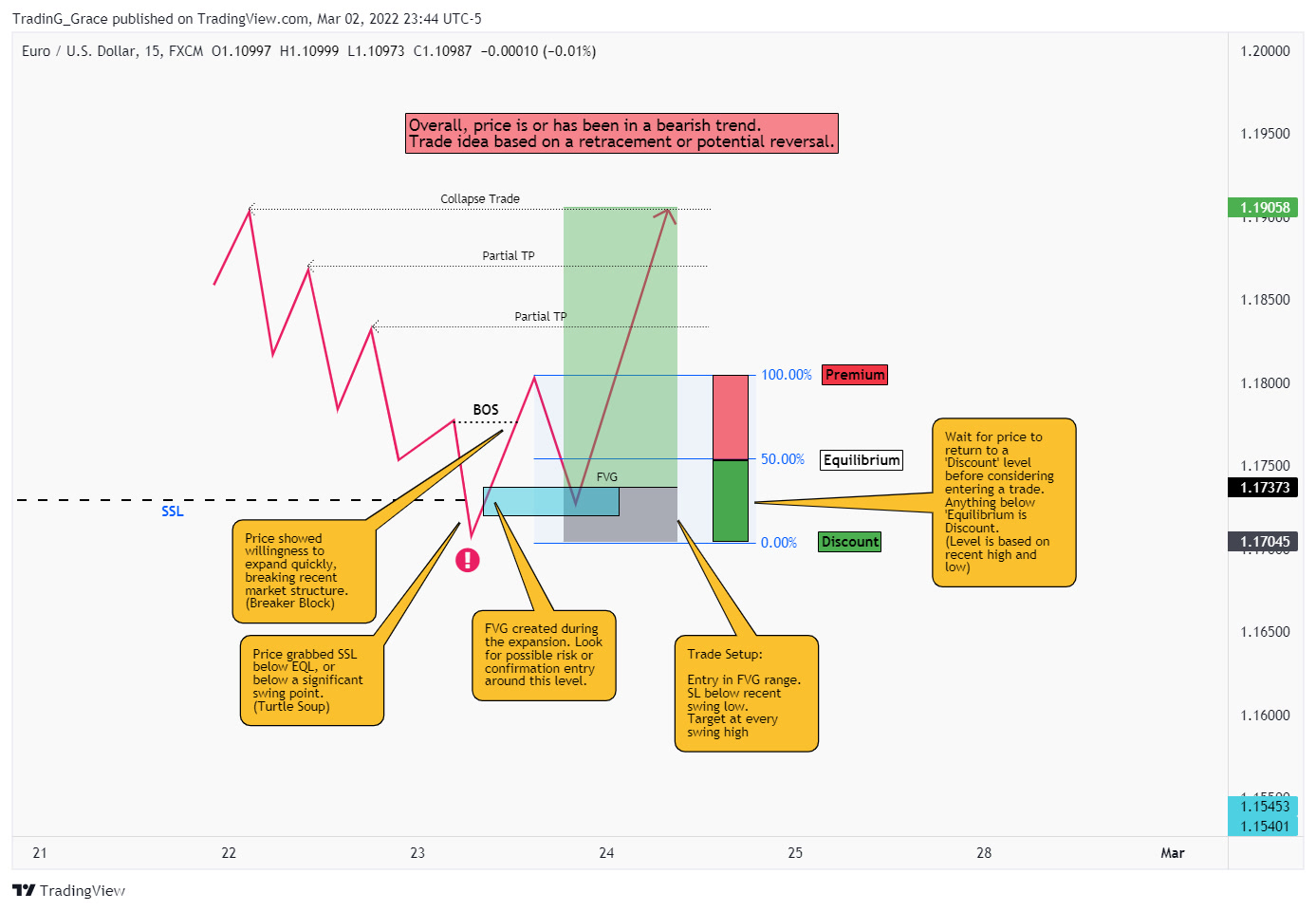
Let me give you a worked example instead of staying abstract about this.
Picture GBPUSD on the 15-minute chart during the London open. Price has swept the Asian session lows overnight, creating a clear inducement below the prior day's structure. Then a strong displacement candle forms moving north, leaving behind a Fair Value Gap. You mark the 50% equilibrium of that FVG.
Price retraces into that gap. The FVG lines up with the mitigation block from the prior day's range on the 1-hour chart, and there's a clear draw toward the 4-hour buy-side liquidity above. The entry is around the FVG equilibrium. The stop goes below the displacement low, because if price takes that out, the bullish move has failed. The target is the 4-hour buy-side liquidity, with partials along the way.
Nothing extraordinary. What makes the trade workable isn't the FVG in isolation. It's the confluence: the liquidity raid on Asian lows giving you the direction read, the mitigation alignment giving you the entry precision, and the identifiable draw giving you a target with logic behind it. Every piece of that is a concept a good course teaches in depth. Every piece of that is something a bad course shows you as a screenshot with arrows.
For a deeper breakdown of how I qualify FVG entries specifically, the ICT fair value gap trading checklist covers exactly that process.
The Archetype That Keeps Getting Burned
There's a very common pattern I see in traders who've gone through the popular high-volume ICT courses and come out the other side frustrated.
They know every concept by name. Order blocks, FVGs, breaker blocks, liquidity voids, optimal trade entry, power of three. They can label a chart like a pro. But the moment they sit in front of live price, they freeze or they over-trade, because they were never taught to think in terms of narrative. They were taught to hunt for shapes.
This trader enters an order block on the 5-minute chart without asking whether price is in a premium or discount relative to the larger range. They enter mitigation setups against the higher timeframe draw on liquidity because the local structure looked clean. They're applying concepts in isolation rather than as part of a sequential framework, and it looks like randomness to them even though it's actually consistent logic being applied incorrectly.
The course they took graded them on whether they could identify the concepts. It never asked them to narrate why price was likely to move in a particular direction before a setup even appeared.
Four Questions That Actually Separate Good Courses From Hype

Before committing money to any ICT trading education, I'd run it through these four questions:
1. Does the course teach draw on liquidity before it teaches entry models? If module one is "what is an order block" and module two is "how to enter an order block," walk away. Understanding where price is going matters more than knowing how to enter. Without liquidity targets, you're just placing trades on pretty shapes.
2. Does the instructor show losing trades with the same detail as winning ones? Anyone can curate a highlight reel. A course worth paying for includes a breakdown of setups that looked valid and failed, with an honest post-mortem about why. Losses aren't embarrassments in this methodology, they're data. If the content you're evaluating only shows winners, that's a red flag about what you're actually buying.
3. Is the content tied to specific market sessions and instruments, or is it presented as universal? ICT concepts are not interchangeable across all instruments and all times of day. The London open kill zone behaves differently than the New York open. Forex pairs move differently than equity index futures. A course that treats setup execution as session-agnostic is teaching you a watered-down version of the methodology. The best ICT trading course content will be specific about when and where each model performs.
4. Can you contact the instructor after the course and get a real answer? Pre-recorded content has limits. Markets evolve, and older content can miss what's happening now. You want access to someone actively trading and willing to engage with your specific questions, not just a library of videos you're locked into forever.
For a broader framework on how ICT concepts and traditional price action stack up in current market conditions, this comparison of ICT smart money concepts vs price action trading is worth your time.
The Contrarian Take Most Creators Won't Say
The original free ICT content, the older YouTube archives and the mentorship series that's been publicly available for years, is still some of the deepest ICT education you can access. The problem is volume and organization, not quality. Most people who say they've "gone through the ICT content" have watched a small slice of it and skipped to the part with setups.
I used to get this wrong myself. Early in my trading, I'd skip the foundational content and head straight to the entry models. I wanted the trade. I didn't want the theory. And I paid for that with inconsistency that took far longer to fix than it would have if I'd just slowed down at the start.
So here's the contrarian take: the best ICT trading course may not be a paid course at all, especially for someone starting out. What separates traders who actually develop an edge is the quality of their deliberate practice and their access to feedback, not the prestige of the course they bought. A $2,000 course watched passively while taking notes is worth far less than $150 spent on targeted coaching that addresses your specific execution problems.
That's precisely why the coaching plans at R2F are structured the way they are. The Lite plan at $150 per week isn't a course with a big price tag, it's accountability and focused feedback on what you're actually doing wrong. The Full Mentorship at $5,000 for four months is for traders who want compressed, intensive development with direct access. The structure exists because passive content consumption and genuine skill development are completely different things.
If you've been grinding the same funded account challenge and hitting the same walls, the 7 fatal mistakes that kill your funded account challenge success article cuts through a lot of the noise quickly.
A Practical Framework for Evaluating What You Already Have
If you're sitting on a course you've already purchased or you're mid-way through a free curriculum, here's a quick audit you can run right now:
Step 1: Pull up a recent losing trade from your journal. Try to explain, in three sentences, why price moved the way it did. Not what happened, but why. If you can't answer that using the concepts you've been taught, the course hasn't given you the right foundation.
Step 2: On a blank chart with no drawings, mark the draw on liquidity for the current session before you identify any entry model. If you find yourself defaulting to looking for setups first, that's a sequencing problem the course created.
Step 3: Ask yourself whether you can trade profitably on an instrument or session the course didn't specifically cover. Genuine understanding transfers. Pattern memorization doesn't.
Position sizing is a separate discipline, but it's equally important. A trade idea with flawed risk parameters will destroy even a correct directional call. Use the R2F risk calculator to make sure your sizing reflects your actual account and conviction level, not a round-number habit.
Also worth noting: if you're completely new to these concepts and trying to figure out where to start, the R2F crash course is the right entry point before you start evaluating any paid education.
The Bottom Line
Searching for the best ICT trading course is a reasonable thing to do. But the search question itself assumes that course quality is primarily about content depth, and that's only half the answer. The other half is whether the environment around the course, the feedback loop, the accountability, the specificity to your actual trading problems, is built to produce behavioral change rather than just conceptual knowledge.
Knowledge of ICT concepts is extraordinarily common at this point. Traders who can execute them consistently under real market conditions are much rarer. Figure out which type of education narrows that gap for you specifically, and that's your answer.
If you want a direct conversation about where you are and what would actually move the needle, book a free discovery call and we'll figure out the right fit together.
Harvest Wright
ICT Trading Coach · 10+ Years Experience
Harvest specializes in ICT methodology and has helped traders pass prop firm challenges, develop consistent strategies, and build the psychology needed for long-term profitability.
Book a Free Discovery Call →Take Your Trading to the Next Level
Get personalized 1-on-1 ICT coaching with Harvest Wright. Free discovery call, no commitment.
Book a Free Discovery CallFree ICT Funded-Trader Playbook
The setups, the pre-trade checklist, and the risk rules I use. Get it free.