
Trading Mentor Red Flags That Cost Traders Thousands
Over 10+ years of trading, I have seen a lot of genuinely talented traders hand over thousands of dollars to people who had no business charging for education. The same trading mentor red flags keep appearing, and the same financial damage keeps following. This article is not a general warning. It is a specific breakdown of why each red flag works as a psychological trap, what it signals about the product underneath, and how to screen any coaching program before you commit a single dollar.
Key Takeaway: The five most reliable trading mentor red flags are guaranteed returns, manufactured urgency, income screenshots as primary proof, refusal to discuss losing periods, and signals packaged as education. Each one reveals a fundamental problem with the product itself, not just the marketing around it.
Red Flag 1: Guaranteed Returns
Anyone guaranteeing a specific return percentage is either lying or has no understanding of how probability works in markets. Those two options are equally disqualifying.
Here is why this matters mechanically: trading performance is path-dependent. A system with a 60% win rate and a 1.5R average winner can still produce a long losing streak. Anyone who has modeled this in a Monte Carlo simulation knows the expected drawdown ranges are wide enough that guaranteeing 10%, 20%, or "consistent monthly income" is not ambitious, it is mathematically incoherent.
The specific language to listen for: "My method guarantees X pips per week", "You will make your investment back within 30 days", or any variation of a promised floor. Regulated financial advisors in most jurisdictions cannot legally guarantee returns on speculative instruments. A trading mentor making this claim is either operating outside that understanding or counting on you not knowing it.
Real coaching teaches probability management. It teaches you to think in distributions, not single outcomes. If a mentor cannot explain variance to you in the first conversation, what are they actually teaching?
Red Flag 2: Urgency to Decide Today
Artificial scarcity is the oldest sales mechanic in existence. In the trading education space, it shows up as "only 3 spots left this month," countdown timers on checkout pages, or the classic "this price is going away tomorrow" email.
Here is the contrarian point most people miss: legitimate, high-quality coaching programs actually do have limited capacity. But there is a difference between real scarcity and manufactured pressure. Real scarcity sounds like "I work with a maximum of eight traders at a time because more than that compromises the quality of feedback I can give." Fake scarcity sounds like a countdown timer that resets every time you visit the page.
The reason artificial urgency is a product quality signal specifically: good programs do not need it. If a curriculum, a methodology, and a track record are genuinely strong, traders come back. They refer others. Cohorts fill organically over weeks or months. The programs that lean hardest on urgency tactics are usually compensating for the fact that traders who take time to do due diligence do not buy.
Ask any coach applying pressure: "Can I have a week to review your track record and speak with a few people who have gone through the program?" Watch what happens. A confident mentor says yes without hesitation. A mentor whose product cannot survive scrutiny will push back.
Red Flag 3: Income Screenshots as Primary Proof
This one is nuanced, so stay with me.
Screenshots of profitable trades are not inherently dishonest. Showing results is part of demonstrating competence. The red flag is when income screenshots are the primary or only form of proof offered, with no context around drawdown, risk percentage per trade, account size, or losing periods.
A screenshot of a $4,200 winning trade tells you almost nothing useful. Was that trade 10% of a $42,000 account or 0.5% of an $840,000 account? What was the stop loss? What happened to the three trades before it? Was this a prop firm challenge account where the trader took oversized risk specifically to generate screenshot-worthy numbers?
I will be honest: early in my career, I used to judge mentors heavily on their wins. I wanted to see the big trades, the green equity curves, the impressive numbers. What I eventually learned is that the most valuable thing any mentor can show you is a detailed losing period, specifically how they managed it, what they did wrong, and how they adjusted. That is the information that actually transfers to your trading.
Hiding losing periods is the norm in this industry, and it should not be.
Red Flag 4: Refusal to Discuss Losing Months
Related to the screenshot problem but distinct enough to deserve its own section.
Every serious trader has losing months. The question is not whether a mentor has had them. The question is whether they will discuss them openly and specifically.
A common pattern I see: traders in various online communities ask a mentor about their worst drawdown, and the mentor deflects with something like "I focus on mindset and process, not on specific outcomes" or "I do not share detailed account data for privacy reasons." These are not answers. They are redirects.
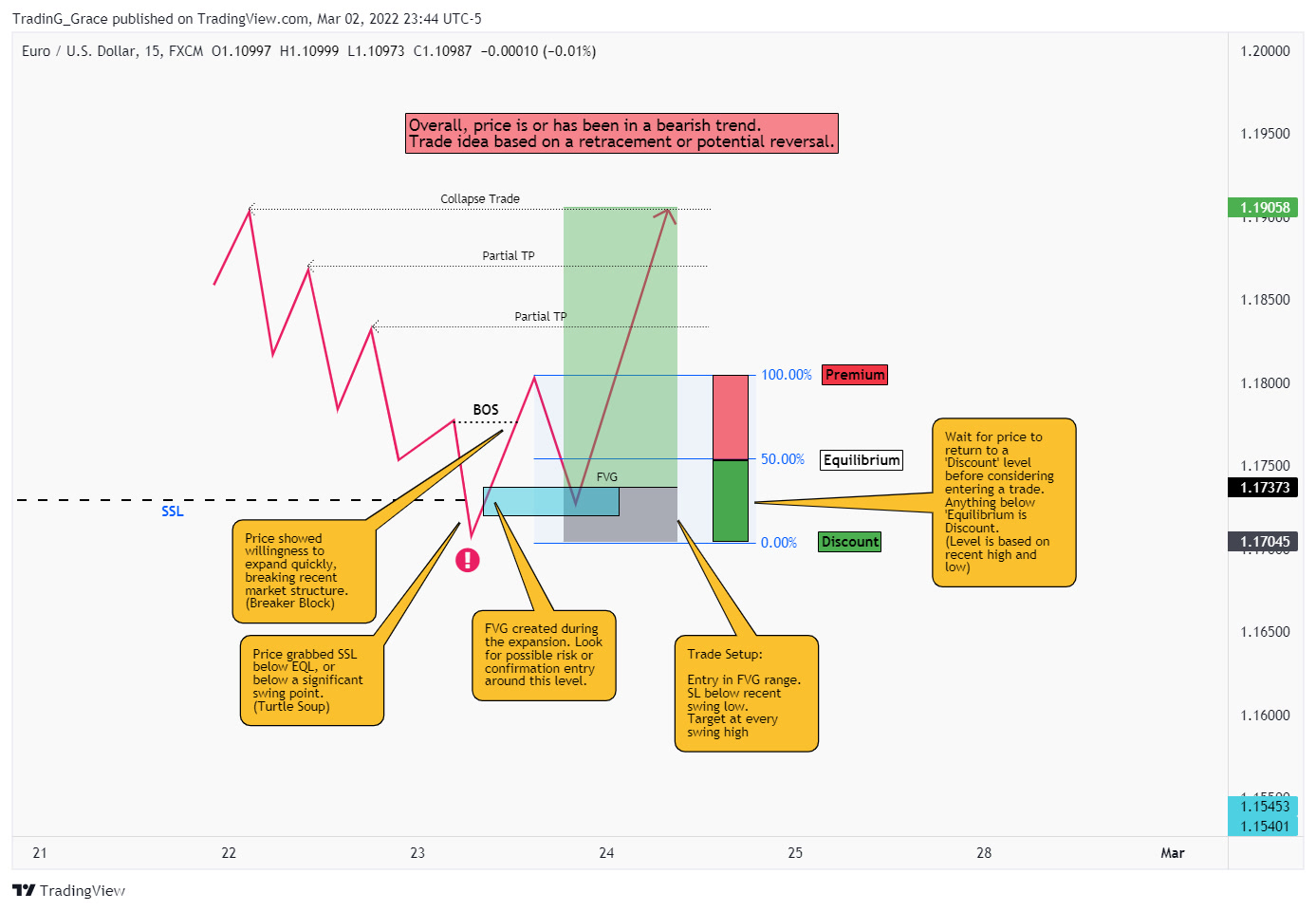
Here is the kind of disclosure I mean. An honest answer sounds something like: "On GBPUSD in the London session, I read a strong displacement after a buy-side sweep above the Asian range and shorted the return to the FVG, with my stop above the gap. It moved my way, then reversed hard on a surprise central bank comment. I had moved my stop to breakeven too early and got taken out. Then I spent the rest of the week trying to re-enter the same narrative, and each attempt stopped out. The real lesson was a bias I carry into sessions after missing a move."
That is the level of specificity a mentor should be able to give you about their losses. If they cannot, or will not, the information asymmetry between what they know about their own performance and what you know is a problem.
Red Flag 5: Signals Sold as Education
This is the one that quietly costs traders the most, because it looks like education on the surface.
A signals service tells you when to buy and sell. Genuine education teaches you the framework so you can identify those moments yourself. The distinction sounds obvious until you are inside a Discord server where the mentor posts "LONG EURUSD now, TP 1.0950, SL 1.0880" and calls it an educational breakdown.
The practical problem: dependency. Traders who follow signals without understanding the underlying logic cannot adapt when market conditions shift. They cannot size positions correctly because they do not know the structural reason for the trade. They cannot manage partial exits intelligently. When the signals stop performing (and they always go through periods where they do), these traders have no foundation to fall back on.
Market character changes. Traders who understand why ICT concepts work in specific environments can adapt. Traders following setups without the underlying framework keep taking losses trying to force the same entries into a different market. This market structure breakdown goes into that in detail.
A useful litmus test: ask a mentor "If I follow your program for four months and you stop posting, will I be able to identify my own setups independently?" The answer should be an immediate, confident yes, with a specific explanation of what you will have learned to look for. If the answer is vague or redirects to "you will always have access to the community," that is a signals model wearing an education costume.
A Framework for Screening Any Mentor Before You Pay
Here is the four-question framework I would use if I were evaluating a coaching program from scratch:
Question 1: Show me a losing month in detail. Not a screenshot. A walkthrough. What happened, what you did wrong, how you adjusted. If they cannot do this, stop the conversation.
Question 2: What is your average risk per trade and what is your maximum drawdown on record? These two numbers together tell you more about a trader's actual approach than any win rate claim.
Question 3: After completing this program, what specific setup types should I be able to identify and execute independently, without your input? The answer should list specific concepts. ICT-based programs should name things like FVG entries at discount arrays, OB mitigation confluences, session-based liquidity targeting. Generic answers about "mindset" or "consistency" without technical specifics are a warning sign.
Question 4: Can I speak with two people who completed the program six months ago or more? Not recent testimonials. Not screenshots. Actual human beings you can ask about their experience after the initial excitement wore off.
If you want to see a coaching structure with clear pricing, the coaching plans page lays that out directly. Lite at $150 per week, Pro at $250 per week, Full Mentorship at $5,000 for four months.
For traders earlier in the process who want a foundation before committing to mentorship, the crash course is worth checking before you start evaluating advanced programs. Going into a mentorship evaluation without baseline ICT vocabulary means you cannot assess whether the curriculum is actually deep or just using technical-sounding language.
The Pattern I Keep Seeing in 2026
A specific archetype shows up repeatedly in trading communities right now. The trader who has been through two or three paid programs, can name-drop ICT concepts fluently, but cannot explain why a specific FVG on a specific timeframe is or is not a valid entry. They absorbed terminology without framework. They paid for signals with educational branding layered on top.
These traders are not undisciplined. They are not lazy. They were given a product designed to create dependency rather than competence, and they paid for it. The trading mentor red flags listed above are exactly how those products market themselves.
For more on what funded account performance actually requires versus what coaching programs often promise, this article on funded trading truths covers the gap in detail.
If you want to evaluate whether R2F Trading's approach specifically is the right fit before spending anything, book a free discovery call. Come with the four questions above. I will answer all of them.
Harvest Wright
ICT Trading Coach · 10+ Years Experience
Harvest specializes in ICT methodology and has helped traders pass prop firm challenges, develop consistent strategies, and build the psychology needed for long-term profitability.
Book a Free Discovery Call →Ready to Get Funded?
Our students pass prop firm challenges in under 60 days with personalized ICT coaching.
Book a Free Discovery CallFree ICT Funded-Trader Playbook
The setups, the pre-trade checklist, and the risk rules I use. Get it free.