
Trading Coach vs Trading Course: Which Do You Need?
Here is the question I get more than almost any other in 2026: trading coach vs trading course, which one is actually worth the money? Most content online dodges this because the person writing it is selling one or the other. I sell both. So let me give you the honest version.
Key Takeaway: A course is the correct starting point when you cannot state your entry criteria in a single, specific sentence. Coaching earns its premium price only after you can already state those criteria clearly and still keep breaking them. Getting that sequence backwards is one of the most expensive mistakes in retail trading.
The One Diagnostic Question That Settles This
Before you spend a dollar on either, answer this out loud:
"What is my entry criteria?"
If your answer takes more than one sentence, or includes the word "sometimes", or sounds like "well it depends on the session and the pair and whether the trend is...", you need a course, not a coach.
Here is why. Coaching is feedback. Feedback only works when there is a repeatable process to give feedback on. If the process itself is undefined, a coach cannot fix it. Trying to coach someone through undefined criteria is like a tennis coach watching someone play for the first time and trying to correct their backhand before they have learned how to grip the racket. The sequence is wrong, and you will pay premium rates for something you could have solved with a $97 structured curriculum.
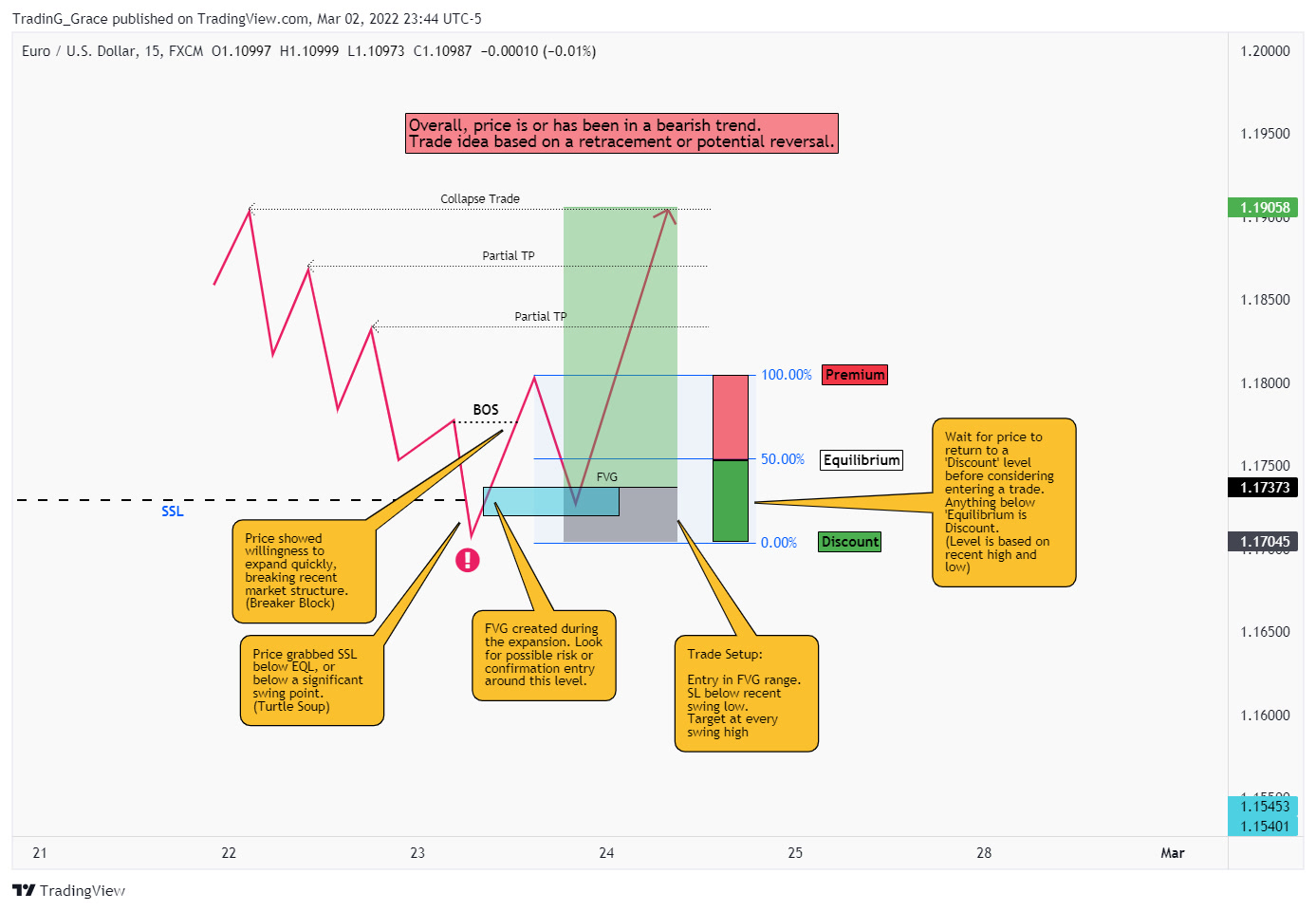
A course is different. A course installs the framework. It gives you the vocabulary, the model, the logic, and the structure. Once you have internalized ICT concepts, fair value gaps, order blocks, liquidity pools, premium and discount arrays, session timing, then you have something worth coaching.
My entry criteria today, for reference: "I trade London or New York killzone displacement into a FVG that forms inside the previous session's dealing range, with confluent OB at a 50% or deeper discount, targeting the opposing side of the most recent range."
One sentence. It took years to compress it down to that.
What a Course Actually Does Well (And Why I Mean That)
Let me be direct: a course does not get enough credit in these comparisons. Most articles frame a course as the "budget option" you settle for when you cannot afford a coach. That framing is wrong.
A course is the correct tool for the vocabulary-building phase. ICT methodology has a specific language. If you do not know what a breaker block is versus a mitigation block, or why a CISD matters differently than a regular MSS, then real-time feedback from a coach will fly over your head. The concepts will not stick because you have no framework to hang them on.
That is not a knowledge gap coaching can efficiently fix in weekly calls. It is a gap that needs structured, repeatable exposure, which is what a well-built course delivers.
For traders who cannot yet state their entry in one sentence, a course is genuinely the better investment. Not because coaching is bad, but because the timing of coaching matters. You can spend $250 a week and walk away with a notebook full of observations that you cannot yet apply, because the underlying model is still loose.
If you are at the beginning, the crash course is the right entry point. Build the vocabulary first. That is not a compromise. That is correct sequencing.
A Trade That Illustrates the Difference
Last Tuesday, August 4th 2026, GBPUSD 15-minute chart. London open had printed a clean displacement candle above the previous day's high, taking out buy-side liquidity, then reversed hard. I identified a FVG on the 15m formed at 1.2934, sitting inside a larger dealing range between 1.2880 and 1.2960. The FVG's 50% level was at 1.2941. Price retraced into that zone at 8:42 AM London time.
Entry: 1.2941. Stop: 1.2958 (above the FVG high and the OB that formed the displacement candle). Risk: 0.5% of the account. The trade moved 2.8R before I took partials at the buy-side pool below 1.2900, closing the remainder at 1.2886.
Now here is what makes that story relevant to the coaching vs course question. That trade is repeatable because every decision in it traces back to a single defined model: displacement, FVG identification, 50% entry, relevant draw on liquidity. Someone in the vocabulary-building phase could watch a recording of that trade and learn from it. Someone who already understands the model but keeps second-guessing their partials, or keeps moving their stop on impulse, or keeps skipping the trade because it "doesn't feel right", that person needs a coach, not another video.
The course teaches the model. The coach holds you to it.
The Archetype Who Gets This Backwards
There is a very recognizable pattern in how traders approach this decision. The trader who has been watching ICT content for six to eighteen months, understands the terminology well enough to discuss it, but has not yet produced consistent results, often concludes the problem is motivation or accountability. So they hire a coach.
What actually happens in those situations is that the coach asks questions about process, and the answers reveal the model is still undefined. The trader can describe what a FVG is but cannot describe their personal criteria for which FVGs qualify for entry. They know what an order block is but they cannot explain which order blocks they trade and which they ignore, in a rule-based way.
Coaching cannot fix that efficiently. A structured course can, in a fraction of the time and at a fraction of the cost. The accountability that the trader was seeking from a coach is not the real problem. The problem is that there is nothing solid enough to be accountable to yet.
The cruel irony: this trader often finishes an expensive coaching engagement, still without consistent results, and concludes that coaching does not work. When what actually happened is that they used the wrong tool for the stage they were at.
When Coaching Is Worth Every Penny
Now flip the scenario. You can state your entry in one sentence. Your backtesting shows the edge is real. Your forward testing shows you execute it correctly maybe 60% of the time, and the other 40% you can describe precisely: you enter early, or you size too large in FOMO, or you exit at 1R because you do not trust the trade to run.
That is a coaching problem, and it is a genuinely hard one to solve alone.
Self-study has a structural limitation here. When the issue is execution psychology, confirmation bias, or process drift under pressure, reading about those things does not fix them. You need someone outside your own head to observe the pattern, name it, and create friction in the moment it typically occurs. That is what a coach does at the craft level.
That is also why our coaching plans are structured across three tiers: Lite at $150 a week for focused feedback on live trade review, Pro at $250 a week for deeper session-level analysis and model refinement, and Full Mentorship at $5,000 for four months for traders who want the complete rebuild with direct access throughout. The price difference is not arbitrary. It reflects how much of my time and attention goes into each arrangement, and how deeply we can go into the friction points that are costing you money.
You can see what that looks like in practice by checking the results page. Real accounts, real progress, documented over time.
A Practical Framework: 4 Questions Before You Spend Anything
Rather than guessing, run through these four questions in order:
1. Can I state my full entry criteria in one sentence? If no, buy a structured course first. Come back to this list when the answer is yes.
2. Is my backtested edge real and documented over at least 100 samples? If no, you still need the course phase. An undocumented edge is not an edge, it is a feeling.
3. Do I know exactly which behavior is costing me money, specifically enough to describe it in a sentence? Examples: "I move my stop loss within the first 30 minutes of every trade" or "I skip entries after two consecutive losses regardless of setup quality." If you can name it this precisely, a coach can create a process around it.
4. Am I willing to be observed and challenged on my reasoning in real time? Coaching is not comfortable. A good coach will ask you to justify every decision and will point out when your justification contradicts your stated model. If that sounds useful, coaching will work for you. If that sounds threatening, you may not yet be ready to extract full value from it.
For position sizing discipline specifically, the risk calculator is a free starting point that removes one common variable from the equation before you ever bring it to a coaching call.
The Honest Version of Pricing
I used to avoid quoting prices directly because it felt awkward. Now I just state them because the awkwardness does not serve anyone.
A decent self-study ICT course runs anywhere from $97 to $500 depending on depth and support. A coaching engagement at professional quality runs $150 to $250 a week. If you spend six weeks in coaching before you have a defined model, that is $900 to $1,500 to learn things a course could have covered for $200.
The math is not subtle. Use the right tool for the stage you are in.
For more on how market conditions in 2026 are affecting execution, the piece on why Q2 2026 market structure shifts are breaking traditional ICT setups is worth reading before you commit to either path. And if you have already been through a course and your funded account challenge is still failing, the 7 fatal mistakes that kill your funded account challenge success piece diagnoses the most common reasons why.
Where to Go From Here
Run the four-question framework above right now, before you click anything else. Write your answer to question one. If you cannot do it in one sentence, a course is your next step. If you can, and questions two through four also check out, then a coaching conversation makes sense.
You can book a free discovery call to talk through exactly where you are in that framework and what the right fit looks like. No pressure toward any tier. The goal is to match the tool to the stage, which is the only way either one actually works.
Harvest Wright
ICT Trading Coach · 10+ Years Experience
Harvest specializes in ICT methodology and has helped traders pass prop firm challenges, develop consistent strategies, and build the psychology needed for long-term profitability.
Book a Free Discovery Call →Ready to Get Funded?
Our students pass prop firm challenges in under 60 days with personalized ICT coaching.
Book a Free Discovery CallFree ICT Funded-Trader Playbook
The setups, the pre-trade checklist, and the risk rules I use. Get it free.