
The Sunday Night Lie Smart Money Traders Tell Themselves
There's a version of Sunday night I've lived hundreds of times. Charts open, notebook out, premium coffee going cold on the desk. HTF bias locked in. A clean narrative built from the weekly close, the daily structure, maybe a macro catalyst or two. By the time I close the laptop, I feel ready. Prepared. Professional.
That feeling is a lie. And for a lot of traders applying smart money concepts right now, that exact ritual, the one every YouTube channel tells you separates the disciplined from the emotional, is quietly destroying their edge before London even opens on Monday.
Key Takeaway: Sunday bias-setting becomes psychologically dangerous the moment you stop treating it as a hypothesis and start treating it as a forecast. Without a pre-built, written invalidation trigger reviewed before Monday's New York open, your weekly prep doesn't protect you from emotional trading, it causes it.
The Problem Isn't the Prep. It's What the Prep Does to Your Brain.
Here's what nobody in the smart money concepts space will say out loud, because admitting it means admitting their methodology can work against them: the more thorough your Sunday analysis, the more emotionally invested you become in being right.
This isn't speculation. It's how the brain works. The moment you articulate a directional story, "DXY looks like it wants to sweep the weekly highs before reversing, so I'm bullish EURUSD into the Asian high", you've given your mind a narrative to protect. And the mind is extraordinarily good at protecting narratives. It will filter every candle that contradicts you. It will re-label a bearish displacement as a "liquidity sweep before continuation." It will hold a losing position through three session opens because the weekly bias "still looks valid on the daily."
I've done all of this. More times than I'd like to count. And I see it constantly in the broader community: in the public trade reviews, the Discord threads, the Twitter spaces where traders are defending their bias from Tuesday through Friday like they're arguing a legal case instead of managing risk.
There's a specific archetype I want to name here, because it shows up over and over: the Analyst Trader. This person's Sunday prep is immaculate. Color-coded zones, annotated HTF charts, a written thesis with bullet points. Their charts look like something from a proprietary desk. But their trading account tells a completely different story, a slow bleed of small losses interrupted by the occasional large loss when price finally invalidated a bias they'd been holding emotionally for four days. The analysis is excellent. The problem is they've confused analysis with trading. Analysis is backward-looking. Trading happens in real time, and real time doesn't care about your Sunday notebook.
'Sell in May': How Macro Hijacks Your ICT Lens
Let me make this concrete with something that comes around every year.
Around May, the "Sell in May and go away" narrative shows up all over financial media. It's a well-known seasonal adage, and it has enough cultural weight in retail trading communities that it shapes how people construct their Sunday bias, especially on equity indices and risk-correlated pairs like AUDUSD or GBPJPY.
So here's what happens: a trader sits down on a Sunday in May, and they're building their NASDAQ or SPX bias. They've absorbed the seasonal narrative. They see a daily structure that could be interpreted as a distribution. They find a weekly bearish FVG. And they build a short bias. Feels iron-clad.
But what they've actually done is reverse-engineered their ICT analysis to confirm a macro story they absorbed from a financial news headline. The smart money concepts framework gets used not to read price objectively, but to decorate a narrative that was already decided. The FVG they found is real. The OB they identified is real. But would they have found the bearish ones specifically if they hadn't already decided it was "Sell in May"? Almost certainly not.
A few weeks later, price does something price always has the right to do, it doesn't cooperate. And the trader who built that bearish bias is now six sessions deep, watching bullish displacement on the 1-hour, and talking themselves into why it's a "trap" instead of accepting that their macro framing corrupted their read from the start.
This is the mechanism. This is exactly how a legitimate educational framework gets weaponized by your own psychology.
A Worked Example
Picture GBPUSD on the 15-minute chart.
The Sunday bias is bearish, for valid reasons: a weekly bearish breaker, DXY showing potential bullish continuation off a daily discount zone, and, if we're honest, the seasonal narrative sitting in the back of the trader's head. Zones are mapped. They're looking for shorts.
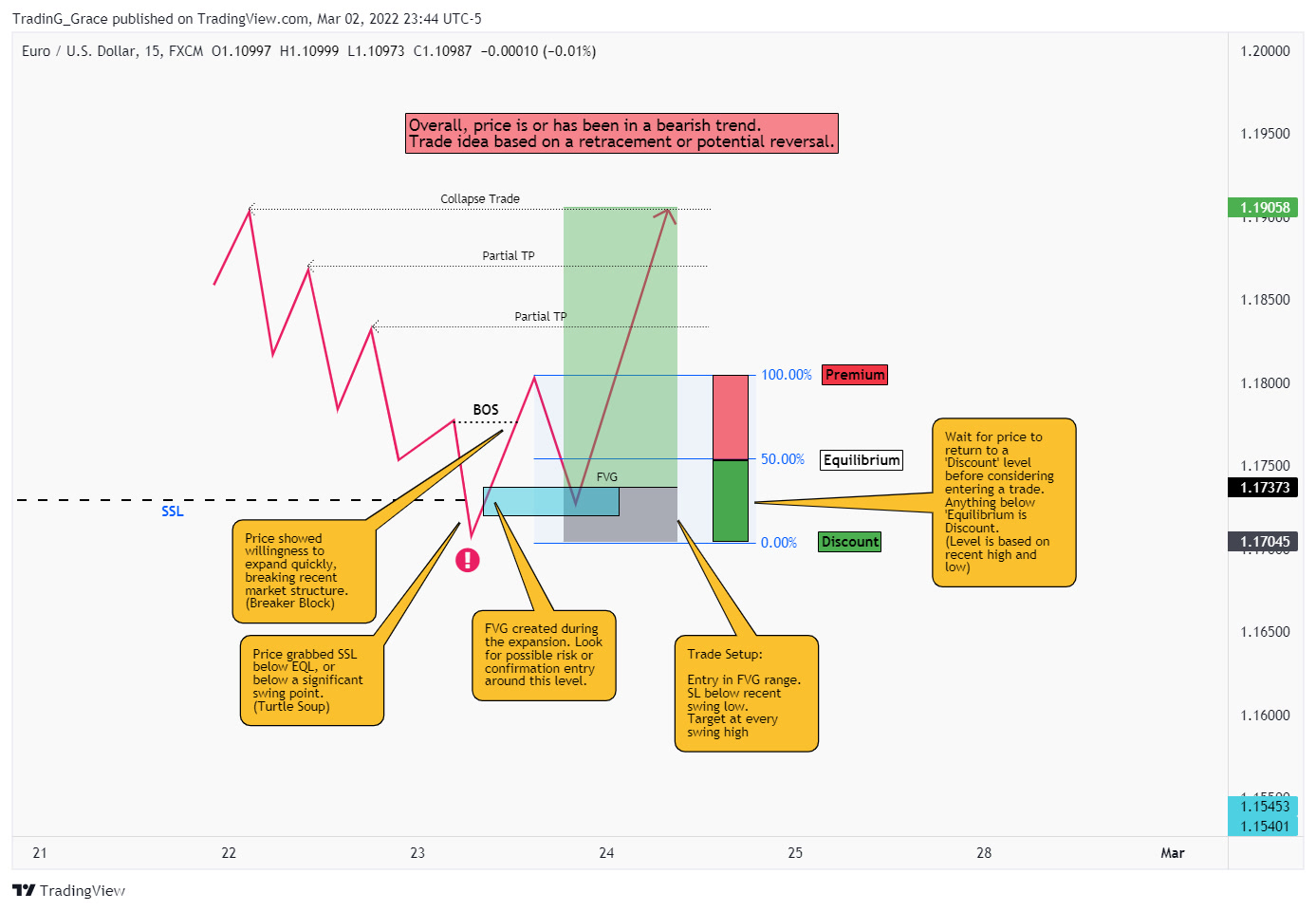
Monday's London session. Price sweeps the Asian high clean, exactly the kind of liquidity raid that in a bearish context should precede a sharp leg down. They watch for displacement. Instead, price prints a bullish FVG on the 15-minute after the sweep, closes a 15-minute candle fully above the Asian high, and starts displacing to the upside. Momentum is wrong for the bias. But they spent two days building that bearish case.
They wait. Two 15-minute candles close bullishly above the equilibrium of the week's range. And then they short anyway, because a small bearish OB on the 5-minute lets them tell the story they want to tell. Price runs through the stop and on up into a daily bullish FVG that was already on their chart, mentally filed as "a target for the short."
The setup that was actually there: long from the 15-minute FVG after the Asian high sweep, stop below the sweep's low, target that daily bullish FVG above. It was labeled correctly on their own chart. They just couldn't use it because the Sunday bias had already decided what side of the market they were on. I've made this exact mistake more than once.
The Bias Invalidation Trigger, What Sunday Prep Is Missing
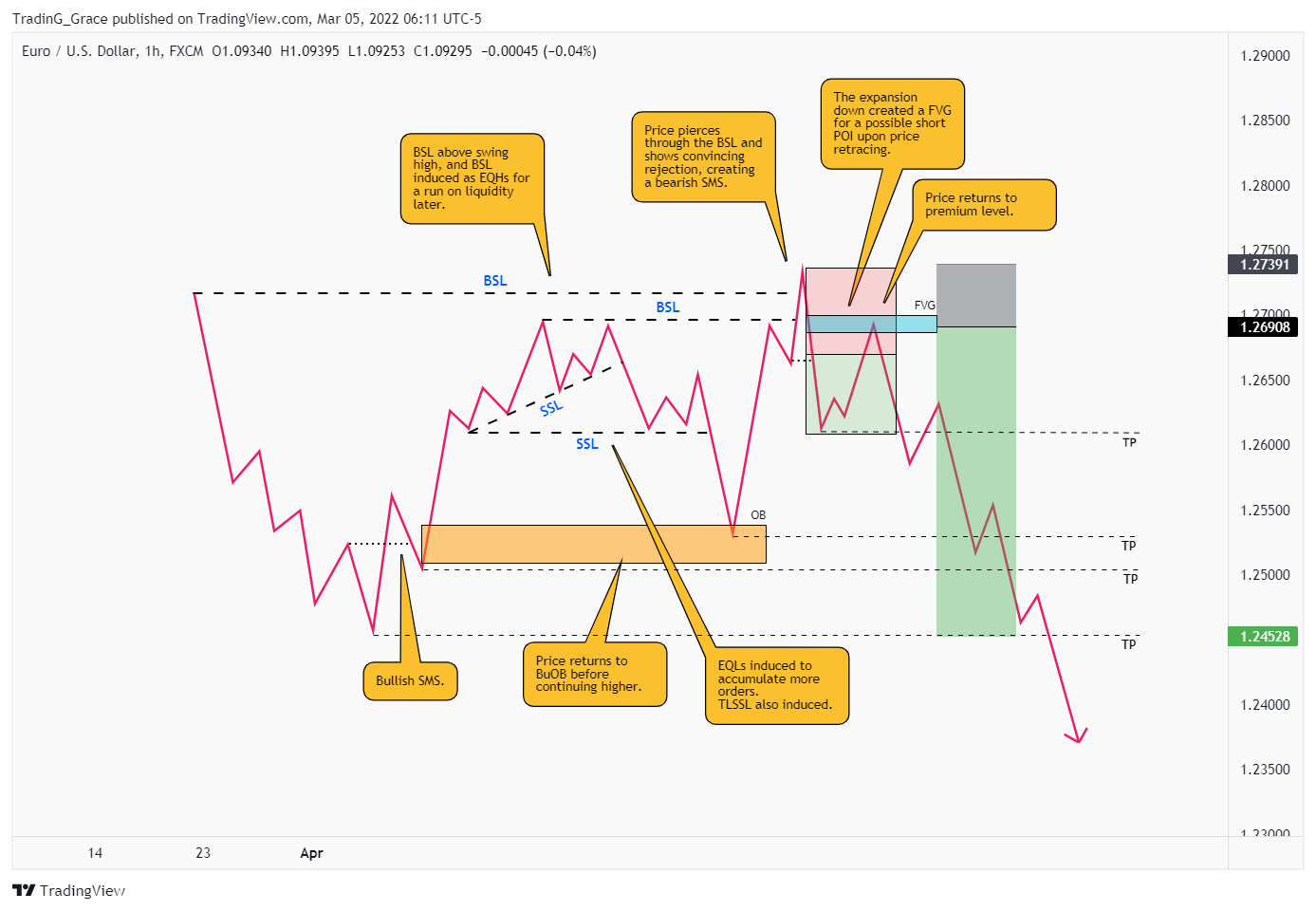
Here's the practical piece. And I mean genuinely practical, not the generic "have an open mind" advice that every trading psychology article recycles without telling you how.
Before every Monday New York open (I do this between 9:00 and 9:15 AM EST), I run what I call a Bias Invalidation Review. It takes eight minutes. Here's exactly what it is:
Step 1, Write the one price level that kills your bias. Not a zone. A specific price. "My bullish bias on EURUSD is invalid if price closes a 1-hour candle below 1.0831." That number goes at the top of my trade plan for the week, in a different color. It's not buried in the analysis. It's the first thing I see.
Step 2, Build the opposing scenario before Monday opens. If I'm bullish, I spend five minutes genuinely finding the best bearish argument price could make. I look for the bearish draw on liquidity, the premium array I'd be targeting if I were short. This isn't to confuse myself, it's to make the alternative scenario familiar so I can recognize it in real time without my brain treating it as a threat.
Step 3, Review the Asian session before committing to any direction. The Asian range is one of the most underused confirmation tools in an ICT framework. Before New York open, where was liquidity built? Was it above or below the midnight open? Price's relationship to the NWOG (New Week Opening Gap) will often tell you more about Monday's likely direction than anything you built on Sunday evening. Check TradingView's session tools, the NY midnight open and Asian range boundaries are visible on any chart.
Step 4, Define your "flip" criteria explicitly. If your invalidation level hits and you haven't lost more than 0.5% in a trade, you're allowed to flip bias. But you write down what the opposing setup needs to look like before you take it. This prevents the reactive flip that's really just revenge trading dressed up as "adapting."
This framework doesn't make Sunday prep irrelevant. The HTF work you do on Sunday is still valuable context. What it does is break the psychological contract you unconsciously make with your own analysis, the one that says I built this bias, so I must defend it.
For anyone deep in funded account challenges right now, I'd also point you toward this breakdown on 7 fatal mistakes that kill your funded account challenge success, because in my view bias rigidity deserves its own line on that list. It's not always over-leveraging. Sometimes it's a perfect 0.5% risk trade taken in exactly the wrong direction for four consecutive days.
And if you're in the camp where market structure has felt disorienting lately, where your smart money concepts setups looked right but didn't follow through, this piece on why Q2 2026 market structure shifts are breaking traditional ICT setups is worth the read before next Sunday's prep session.
One More Thing Nobody Says
The traders who've been applying smart money concepts for long enough, we're talking five, six, seven years minimum, they don't sit down on Sunday and build a story. They sit down and build a decision tree. There's a fundamental difference. A story has a protagonist. A decision tree has branches.
"If price does X, I'm looking for Y in this zone. If price instead does A, I'm looking for B in that zone." No protagonist. No ego attached to the direction. Just conditions and responses.
Getting to that mental model takes time. I'm not pretending it's easy to flip the switch on, especially if you've built your trading identity around being the person who "called" the weekly direction correctly. But in my experience, the funded accounts and consistent equity curves that hold up over quarters tend to belong to the decision-tree thinkers.
If you want to work through what this looks like applied to your specific setup and timeframe, the coaching plans at R2F walk through this exact framework in both the Lite ($150/week) and Pro ($250/week) tiers. Or if you're just starting to build your ICT foundation and Sunday prep feels overwhelming before you even get to the psychology layer, the crash course is the right starting point.
But before any of that, next Sunday, before you close the laptop and feel that dangerous sense of certainty: write down the one price level that proves you wrong. Then sleep on it.
That's it. That's the step that separates the traders who use their Sunday prep from the ones who get used by it.
Harvest Wright
ICT Trading Coach · 10+ Years Experience
Harvest specializes in ICT methodology and has helped traders pass prop firm challenges, develop consistent strategies, and build the psychology needed for long-term profitability.
Book a Free Discovery Call →Ready to Get Funded?
Our students pass prop firm challenges in under 60 days with personalized ICT coaching.
Book a Free Discovery CallFree ICT Funded-Trader Playbook
The setups, the pre-trade checklist, and the risk rules I use. Get it free.