GDP Shock? How Traders Spiral Into Revenge Mode
Everyone talks about revenge trading like it's a simple cause-and-effect story: you lose a trade, you get angry, you overtrade, you blow up. Clean, logical, easy to warn people about. But that version of the story has never fully matched what I've actually watched happen, to myself included, over more than a decade of trading.
The real trigger for revenge trading isn't a losing trade. It's the moment a piece of macro data, a GDP print, a CPI shock, an unexpected NFP, makes you feel like the entire analytical framework you've been building for weeks is suddenly worthless. That's a completely different emotional event, and it creates a far more dangerous spiral.
Key Takeaway: Revenge trading is most commonly triggered not by a single loss, but by narrative invalidation, when macro data like a GDP surprise destroys a directional bias you've emotionally invested in. ICT traders are uniquely vulnerable because their analysis is inherently story-based, making ego attachment to the thesis almost unavoidable.
The Myth Everyone Repeats About Revenge Trading
Myth: Revenge trading happens because a trader loses a trade, feels emotional, and immediately starts firing off impulsive entries to "make back" the loss.
Reality: That version exists, but it's the shallow end. The traders who blow accounts aren't usually doing it after one bad entry on a Tuesday morning. They're doing it after three or four days of watching the market move against a thesis they were certain about, and then a major data release lands and removes all remaining doubt.
What I Actually See: The trader who rage-fires five positions in 40 minutes on GDP release day didn't start unraveling that morning. They started unraveling the Monday before, when price failed to respect what looked like a pristine weekly order block. They talked themselves into staying in the thesis. They added reasons. By Thursday, GDP day, they weren't just placing trades. They were defending an identity.
That's a different beast entirely.
Why ICT Analysis Builds Stronger Narrative Attachment
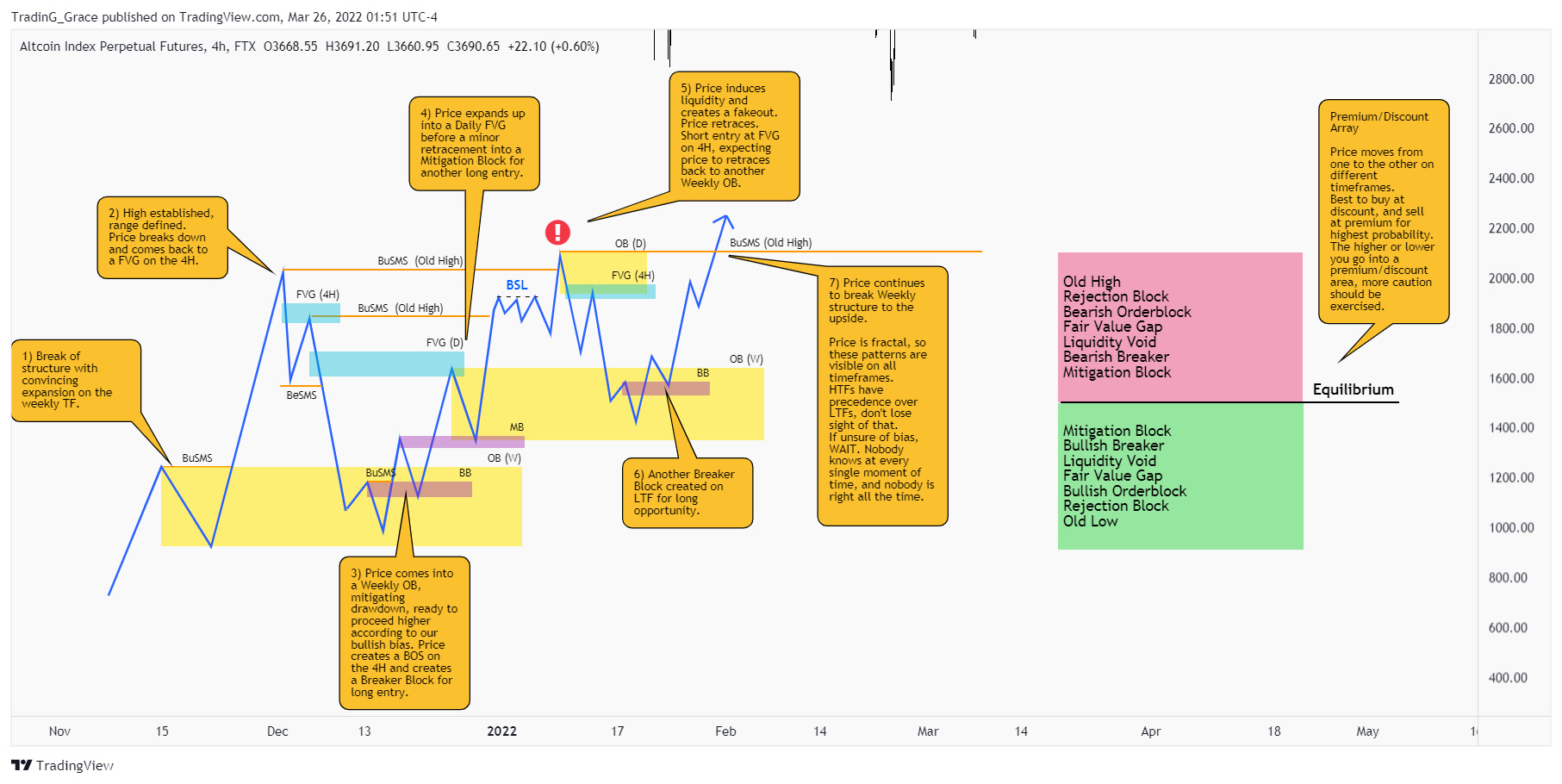
Here's the thing nobody in the ICT YouTube space wants to say out loud: the more sophisticated your market structure analysis, the more emotionally dangerous a macro surprise becomes.
When you're analyzing price through an ICT lens, you're not just drawing lines. You're constructing a narrative. You're identifying institutional order flow, reading inducements, mapping liquidity pools above and below price, tracking whether smart money is in accumulation or distribution. You're essentially writing a story about what the market intends to do, and good ICT analysis means that story has detail, internal logic, and a lot of your time invested in it.
That's both the power and the trap.
A trader using a basic moving average crossover system doesn't have much ego invested in a directional call. The signal fires or it doesn't. But an ICT trader who has spent four hours on a Sunday mapping the weekly range, identifying the premium array rejection, marking the breaker block, confirming the HTF bias, that trader has written a thesis. And when GDP drops and price rips 150 pips in the opposite direction in 12 minutes, it doesn't just invalidate a trade. It feels like it invalidates their competence.
That's the cognitive dissonance event that triggers the spiral.
The Exact Loop: Conviction → Surprise → Denial → Overtrading
Let me walk through what this actually looks like in sequence, because naming the stages is the first step to catching yourself inside one of them.
Stage 1, Conviction: You've done your homework. Strong HTF bearish structure on DXY. Weekly order block sitting overhead on EURUSD. FVGs aligning with a premium distribution zone. Everything points to continuation lower. You're positioned short, stops are placed, thesis is solid. This isn't overconfidence, this is proper preparation.
Stage 2, The Surprise: GDP data releases. The number crushes expectations, or misses catastrophically. Price doesn't care about your order blocks. It gaps through your liquidity levels, hunts every short stop in sight, and closes the week well above your invalidation point. Not a minor deviation. A full structural break of your entire read.
Stage 3, Denial: This is where it gets dangerous, and it's also where it gets subtle. Denial in trading doesn't look like screaming at your screen. It looks like rationalization. "This is just a liquidity raid above the weekly high before continuation lower." "Smart money is engineering a move to trap longs before the real drop." "The GDP number will be revised, this move is fake." Every one of those thoughts sounds like ICT analysis. None of them are. They're denial wearing the costume of methodology.
Stage 4, Overtrading: With the original thesis now repackaged as "still valid, just delayed," the entries start. Not one entry, entries. Each one slightly more leveraged than the last. Each one justified by a new micro-structure read that conveniently supports the original directional bias. The position size creeps up because unconsciously, you need the potential recovery to match the emotional scale of being wrong.
In my experience, that sequence does more damage than the simple "I lost a trade and got mad" version.
A Worked Example
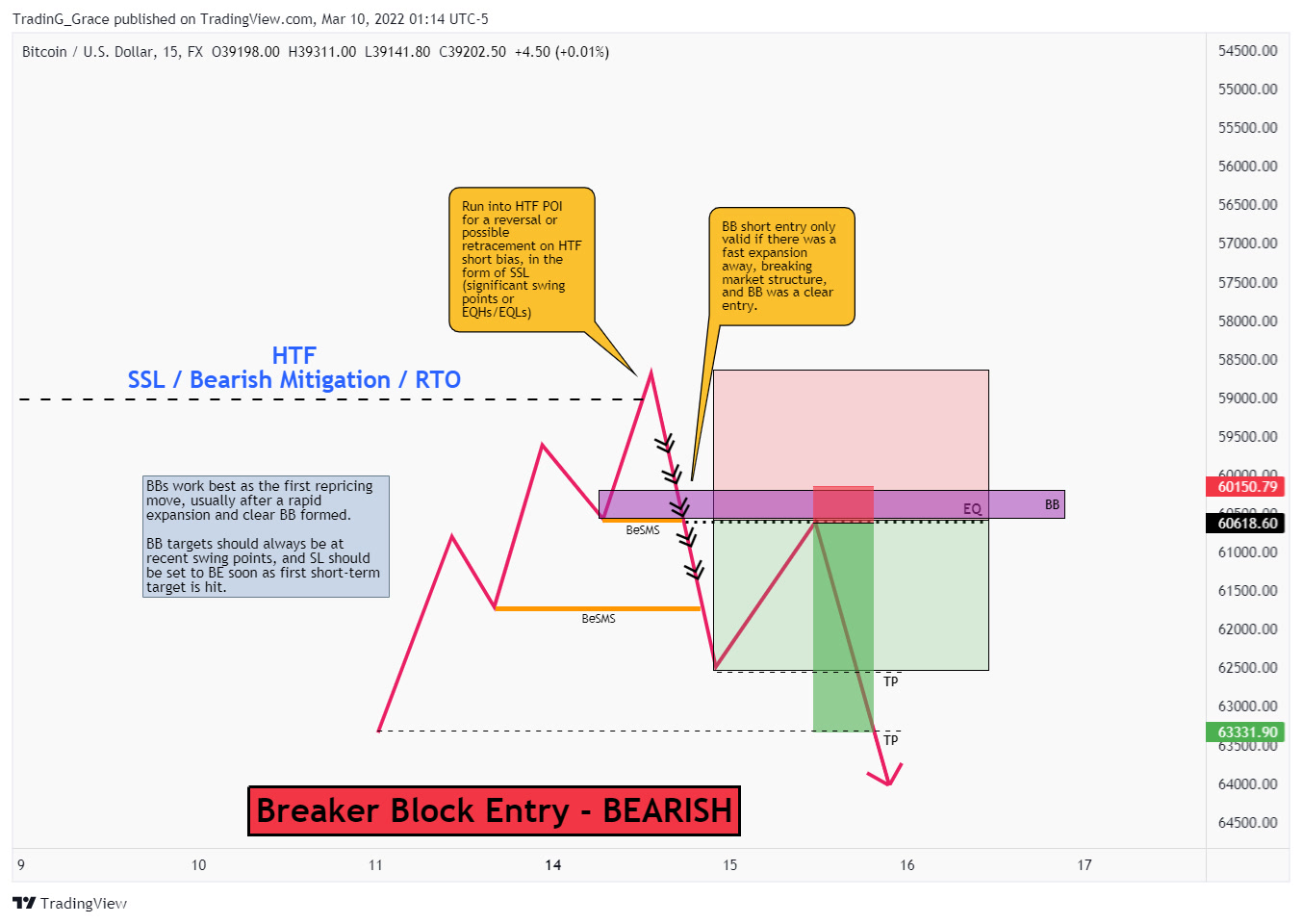
Here's what this can look like. Picture a bearish GBPUSD bias heading into a macro data week. The setup is genuinely clean: displacement lower off a 4H order block, a clear FVG on the 1H that hasn't been filled, and a daily structure that looks like textbook distribution. The short goes on from the 15-minute chart, with the stop above the 4H order block, because if price trades back through it the bearish idea is wrong. Risk is small and planned. No alarm bells.
Then the GDP number surprises, and GBPUSD rips through the stop, through the FVG, through the OB, and tags the weekly high within the session.
The loss itself? Manageable. A small, planned risk is not a crisis.
What the trader feels is the problem. It isn't just a lost trade. It's hours of analysis erased in half a session. And for a while after that, they're in Stage 3 without realizing it, scanning every 15-minute candle for the "real" structure that proves they're still right. Each time they find micro-structure evidence that technically supports the original read, the urge to re-enter short comes back.
That urge isn't analysis. It's ego management. Learning to recognize the feeling is what lets you sit on your hands instead of taking those extra entries.
The Archetype I Keep Seeing
There's a particular type of trader who shows up in forums and Discord servers after every major macro surprise event, and the pattern is almost identical every time. They post a chart, usually a 5-minute or 15-minute view, and they're asking whether a specific candle formation is an order block or a breaker. The ask looks technical. But when you scroll up in the thread, you see they've already taken three trades in the same direction over the past two hours, all of them losses, all of them stopped just before a significant move in their intended direction.
They're not asking a technical question. They're asking for permission to take the fourth trade.
This trader isn't lacking knowledge of ICT concepts, often they know the material very well. What they're missing is the awareness that their question itself is a symptom of narrative over-investment. When you find yourself hunting through multiple timeframes trying to construct a reason why your original bias is still intact after a macro shock, you're not doing analysis anymore. The conclusion came first. The analysis is reverse-engineered justification.
For more on how market structure setups can fail when approached through a confirmation-bias lens, especially in volatile Q2 conditions, this breakdown of order block failures in ranging markets is worth reading alongside this one.
A Practical Framework: The Post-Shock Protocol
Here's what I actually do after a macro surprise invalidates an active bias, not advice, not theory, just the exact sequence:
Step 1, Mandatory flat period. No new positions for a minimum of 60 minutes after the initial shock candle. Non-negotiable. The market will still be there. This isn't about waiting for volatility to calm down, it's about giving your narrative-brain enough time to stop being the loudest voice.
Step 2, Invalidation review, not rescue. Open a clean chart. Ask one question only: "Does the HTF structure still support my original bias, or has it broken?" A clear break of a weekly high or low in the direction opposite your thesis is invalidation. Full stop. Not "a liquidity raid" unless you can point to a specific draw on liquidity above that level that was established before the move, not identified after.
Step 3, Position sizing reset. If you re-enter after a macro shock and the new bias is genuine, the size goes down, not up. Use the risk calculator and drop to 0.5% maximum on the first re-entry after a major data event, regardless of how clean the setup looks. The market owes you nothing for being early or "almost right."
Step 4, Bias documentation. Before any new entry after a shock event, write out in plain language, not ICT terminology, why price should go in your intended direction. If you can't explain it without jargon, you don't have clarity. You have a hope wearing the clothes of a thesis.
This protocol won't eliminate losses after macro surprises. Nothing will. But it creates enough friction between the emotional impulse and the execution that you catch yourself in Stage 3 more often than not. That's what staying funded through volatile conditions actually requires, not perfect setups, but a reliable brake system.
The Uncomfortable Truth About "Reading the Market"
Here's something that took me years to fully accept: macro data does not care about your order blocks. Institutional order flow does not pause for your 4H FVG. There are sessions, usually surrounding major data releases, where the price action is genuinely not about smart money engineering liquidity in the way ICT methodology describes. Sometimes GDP just prints, algos react, and price moves because the fundamental input changed. Full stop.
The traders who handle macro surprises best are the ones who hold their ICT analysis loosely enough to abandon it quickly when the data says otherwise. The ones who spiral into revenge trading are the ones who spent so long building the thesis that abandoning it feels like admitting they wasted their week.
You didn't waste your week. You got new information. Update the model.
And if you consistently find that macro events are derailing your structure reads, that's worth addressing at the methodology level, not just the psychology level. The Q2 2026 market structure piece covers exactly why some of the standard ICT playbook has needed recalibrating in the current environment.
What To Do Next
If you recognized yourself somewhere in that conviction → surprise → denial → overtrading loop, the first thing to do is map where in the loop you typically get stuck. Most traders can catch Stage 4, they know when they're overtrading. Far fewer can catch Stage 3 in real time, because denial in this context is indistinguishable from legitimate re-analysis.
The best diagnostic question I've found: "Am I looking for evidence that my thesis is correct, or am I genuinely open to evidence it's wrong?" If the honest answer is the former, close the charts for the session.
If you want to work through how narrative over-investment shows up specifically in your own trading, and build a framework that holds up through macro shock events, take a look at the coaching plans here. The Lite plan at $150/week gives you one 1-on-1 session a week for this kind of psychological-meets-technical accountability, and the Full Mentorship at $5,000 for four months goes deep enough to rebuild how you approach bias construction from the ground up. There's also a free discovery call if you want to talk through where you're at before committing to anything.
Harvest Wright
ICT Trading Coach · 10+ Years Experience
Harvest specializes in ICT methodology and has helped traders pass prop firm challenges, develop consistent strategies, and build the psychology needed for long-term profitability.
Book a Free Discovery Call →Master Your Trading Psychology
Psychology is a huge part of trading. Our coaching includes dedicated psychology sessions.
See Coaching PlansFree ICT Funded-Trader Playbook
The setups, the pre-trade checklist, and the risk rules I use. Get it free.