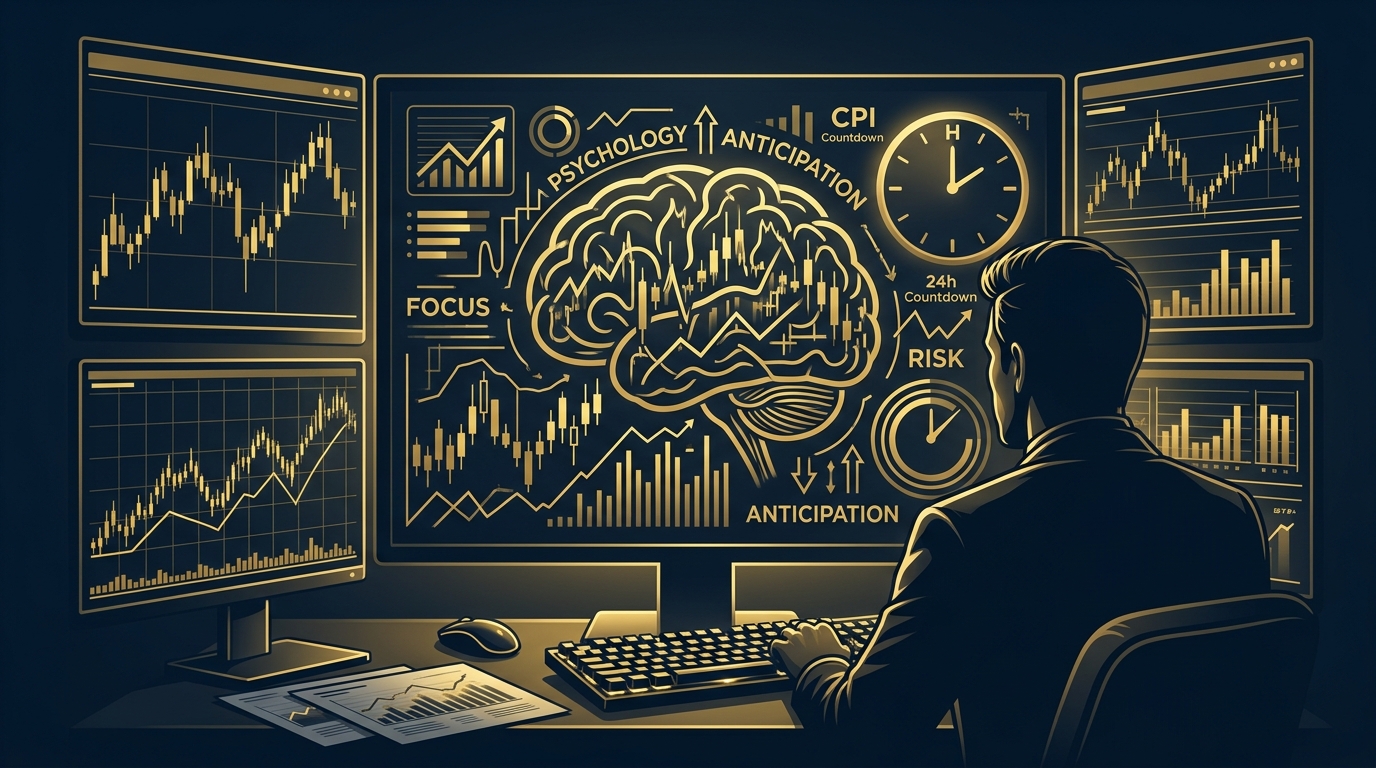
CPI Trading Psychology: The Pre-Data Mental Game
Anyone who has traded a CPI release on gut feel knows the sick feeling of watching price rip through a stop in seconds. That feeling is the heart of CPI trading psychology, and it's why so many retail traders get hurt during high-impact news events while smart money quietly positions for the chaos.
After 10+ years of trading, with ICT concepts for a good part of that, and passing an FTMO Challenge, I've seen the same psychological patterns play out release after release. The 24 hours before CPI data drops reveal more about market psychology than any textbook ever could.
Key Takeaway: Managing your psychology before a CPI release, not during it, is what separates consistent traders from blown accounts; establish your bias, define your invalidation levels, and commit to your plan hours before the data drops so emotion has nothing left to hijack.
The CPI Trading Psychology War: What Really Happens 24 Hours Before
Here's what I've observed studying smart money behavior versus retail psychology during pre-CPI sessions:
Smart money operates with surgical precision. They're not frantically checking economic calendars or refreshing Twitter for hot takes. Instead, they're identifying liquidity pools, marking key levels, and positioning size based on predetermined risk parameters.
Retail traders, meanwhile, are in full panic mode. Discord servers explode with "CPI predictions," YouTube gurus pump out last-minute strategy videos, and social media fills with hot takes about what the numbers "should" be.
I've been there. Earlier in my trading, I was part of the retail crowd around news, checking feeds obsessively, adjusting position sizes based on "gut feelings," and letting emotions drive every decision. Smart money was quietly accumulating while I was busy being part of the noise.
The Emotional Death Traps That Kill Accounts During CPI Week
These are the psychological traps I see come up again and again:
Trap #1: The Prediction Addiction
Retail traders become obsessed with predicting CPI numbers. They'll spend hours analyzing consensus estimates, reading economist opinions, and trying to "outsmart" the market.
Smart money doesn't predict, they react to price action and liquidity sweeps with predetermined plans.
Picture a trader who is so focused on being right about the number that they skip every ICT principle they know and load up before the release. That's how funded accounts disappear in a single print. This connects directly to the fatal mistakes that kill funded accounts, letting ego override process.
Trap #2: Size Inflation Syndrome
The anticipation of "big moves" causes traders to increase position sizes, thinking they'll capture massive profits from volatility spikes.
This is backwards thinking. Smart money often reduces size during high-impact news because they understand that increased volatility means increased risk, not increased opportunity.
Trap #3: The Social Media Echo Chamber
Platforms like TradingView become dangerous during CPI week as confirmation bias runs wild. Traders seek out opinions that match their existing positions rather than maintaining objectivity.
I've made this mistake myself, getting caught in Twitter threads about "guaranteed CPI plays" instead of focusing on price structure and liquidity concepts.
The ICT Mental Framework: How I Stay Disciplined When Volatility Spikes
After years of studying smart money behavior and developing my approach through ICT concepts, I've built a mental framework that keeps me grounded during high-impact news events:
The 24-Hour Rule
24 hours before CPI, I implement a complete information blackout. No economic predictions, no social media trading content, no "expert analysis." This isn't about being uninformed, it's about maintaining mental clarity.
Instead, I focus on:
- Identifying institutional order flow
- Marking premium and discount arrays
- Planning liquidity grab scenarios
- Setting maximum risk parameters
The Smart Money Positioning Study
I spend time analyzing how price has moved in the 48 hours leading up to CPI. Smart money often telegraphs their intentions through subtle accumulation or distribution patterns that most retail traders miss.
This ties into concepts I've covered in my analysis of how smart money positions using ICT order blocks during pre-CPI sessions.
The Liquidity Mindset Shift
The biggest psychological shift that transformed my CPI trading was stopping thinking about "news impact" and starting thinking about "liquidity engineering."
CPI doesn't move markets, it provides the catalyst for smart money to engineer liquidity sweeps they've been planning for days or weeks. Once I understood this, high-impact news became less about predicting outcomes and more about identifying where institutional players needed price to go.
The Calm Before The Storm: What Smart Money Really Does
Watching professional order flow during the 24 hours before CPI releases reveals fascinating patterns:
Morning of CPI (6-10 AM EST): Smart money often engineers false breakouts to trap retail traders in poor positions before the actual data.
Pre-market positioning: Institutional players will quietly accumulate or distribute size without creating obvious footprints.
Hedging activity: Institutions hedge ahead of big data, and most retail traders never think about it.
Learning to read these subtle signs, instead of getting caught up in the emotional chaos of CPI week, is something we can work on together in the Full Mentorship program.
Personal Lessons: How I Rebuilt My CPI Psychology
The change didn't happen overnight. I had to rebuild my whole approach to high-impact news trading.
Key changes I made:
- Reduced position sizes during news events (opposite of what most retail traders do)
- Focused on post-CPI liquidity sweeps rather than trying to catch initial moves
- Developed specific ICT setups that work well in high-volatility environments
- Created psychological anchors to maintain discipline when emotions spike
These lessons carry straight over to prop firm challenges, where one bad news day can end an attempt. Understanding the psychological game is often more important than having perfect technical setups, something I explore in detail when discussing the truth about funded trading.
The Professional's Approach: Staying Calm in The Chaos
After years of experience, I've learned that the best CPI trading psychology comes down to one core principle: emotional detachment from outcomes.
Smart money treats CPI releases like any other trading day. They have plans, they execute those plans, and they adapt based on price action, not emotions.
The retail trader's mindset: "This CPI release will make or break my account." The professional's mindset: "This is one trade among hundreds I'll make this year."
This psychological difference creates entirely different trading behaviors and, ultimately, entirely different results.
Building Your CPI Mental Framework
If you're struggling with CPI trading psychology, here's how to start building the mental discipline that separates professionals from amateurs:
- Practice information discipline 24 hours before releases
- Focus on liquidity concepts rather than news predictions
- Reduce position sizes during high-impact events
- Study smart money positioning instead of retail sentiment
- Develop specific post-news strategies for various scenarios
These principles take time to internalize. If you want help building that discipline, that's what my 1-on-1 coaching programs are for.
The Bottom Line
CPI trading psychology isn't about having ice in your veins or being emotionless. It's about understanding the game being played and positioning yourself with the smart money instead of against them.
The next time you see retail traders panicking 24 hours before CPI data drops, remember: that chaos is exactly what smart money counts on. While the crowd is busy predicting, professionals are quietly positioning.
If you're ready to develop the mental framework that separates winning ICT traders from the crowd, book a free discovery call and let's discuss how to transform your approach to high-impact news trading. The psychological game is learnable, but only if you're willing to do the work.
For more insights on developing professional-level trading psychology and ICT concepts, explore our trading insights section where I regularly share lessons learned from over a decade of market experience.
Harvest Wright
ICT Trading Coach · 10+ Years Experience
Harvest specializes in ICT methodology and has helped traders pass prop firm challenges, develop consistent strategies, and build the psychology needed for long-term profitability.
Book a Free Discovery Call →Master Your Trading Psychology
Psychology is a huge part of trading. Our coaching includes dedicated psychology sessions.
See Coaching PlansFree ICT Funded-Trader Playbook
The setups, the pre-trade checklist, and the risk rules I use. Get it free.