By Harvest Wright, updated 5 November 2026
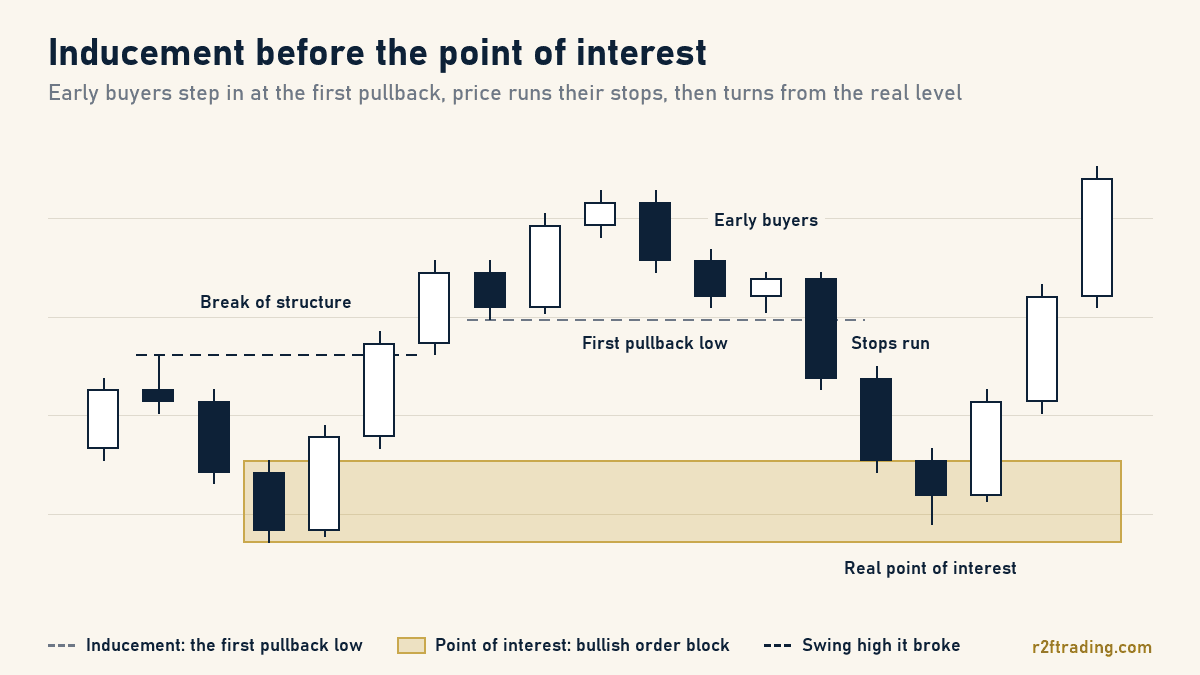
Inducement in trading is an obvious, nearby pool of liquidity that tempts traders into an early entry before price reaches the real point of interest. It is usually the first pullback, a minor swing, a trend line or equal highs or lows, and price often takes that liquidity first, stopping out the early traders, before it turns at the level that matters. Inducement is mainly a smart money concepts (SMC) term, often shortened to IDM. ICT describes the same behaviour as liquidity: stop runs, relative equal highs and lows, and the Judas swing.
What is inducement in trading?
Every entry comes with a stop. A trader who buys the bounce off a minor low puts a sell stop just under it, and large players need orders like that to fill a big position. Inducement is the level that builds the cluster of stops: it looks like a good place to get in, so traders do, and their stops become the fuel that carries price to the real level.
That real level is the point of interest: a higher timeframe order block, fair value gap or other PD array further on. Traders who take the bait get stopped out, then watch the reversal start there without them.
Where inducement forms and how to spot it
Start from where price is going and work backwards. Mark the higher timeframe point of interest, then look at what sits between price and that level. Anything that looks like a perfect early entry, and that plenty of traders can see, is a candidate:
- The first pullback. After a break of market structure, the first minor low in a bullish leg, or minor high in a bearish one, is the classic SMC inducement.
- [Equal highs and equal lows](/learn/equal-highs-and-equal-lows-ict). Two touches at the same price look like solid support or resistance, so stops pile up just beyond them.
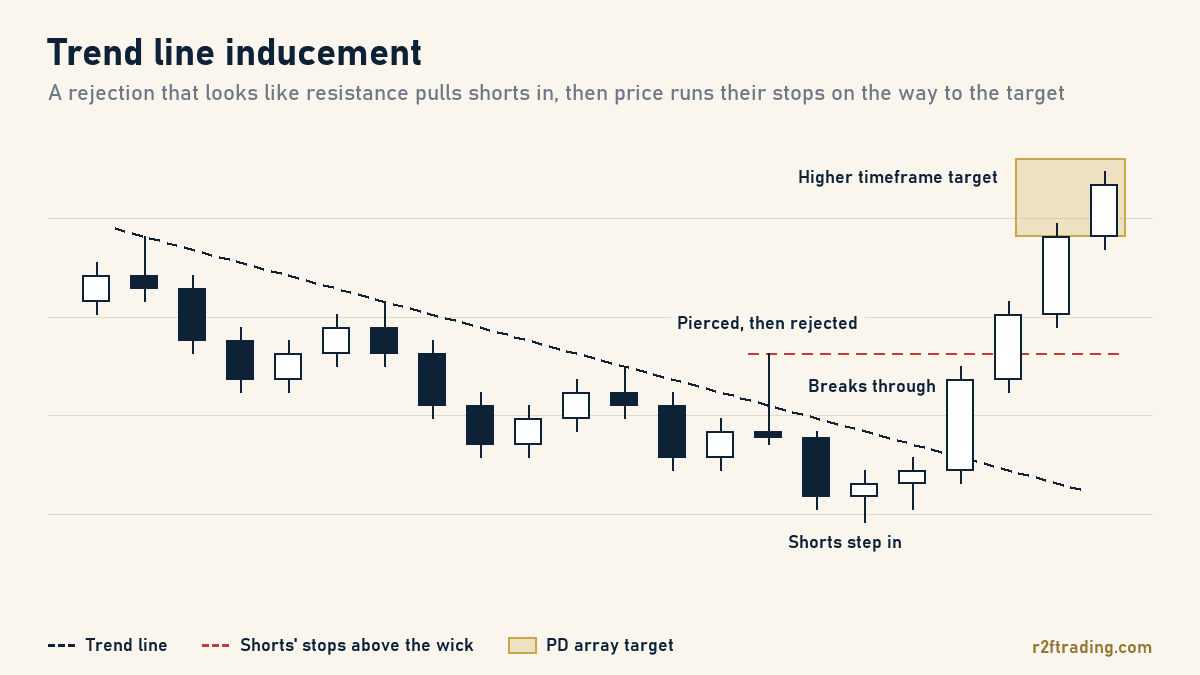
- Trend lines. A line with clean touches invites traders to trade the next one, with stops just past the line.
- An early zone. A small order block or gap sitting in front of the real one.
Is inducement an SMC term or an ICT term?
Inducement, or IDM, is mainly a smart money concepts term, and SMC teachers use it in two ways. In the strict version, the inducement is the first pullback after a break of structure, and a point of interest only counts once price has taken it. In the loose version, it is any obvious liquidity in front of the point of interest. More on the split in ICT vs SMC.
ICT (Michael J. Huddleston) explains the same behaviour through liquidity:
- Buy side and sell side liquidity: stops above old highs and below old lows, with relative equal highs and lows as the cleanest pools.
- Stop runs: price reaching into a pool, filling against the stops, then moving on or reversing.
- The [Judas swing](/learn/what-is-a-judas-swing): a false move near the session open that pulls traders the wrong way.
- The manipulation leg of the [power of three](/learn/ict-power-of-three-explained), where traders get drawn in on the wrong side.
Inducement vs liquidity sweep
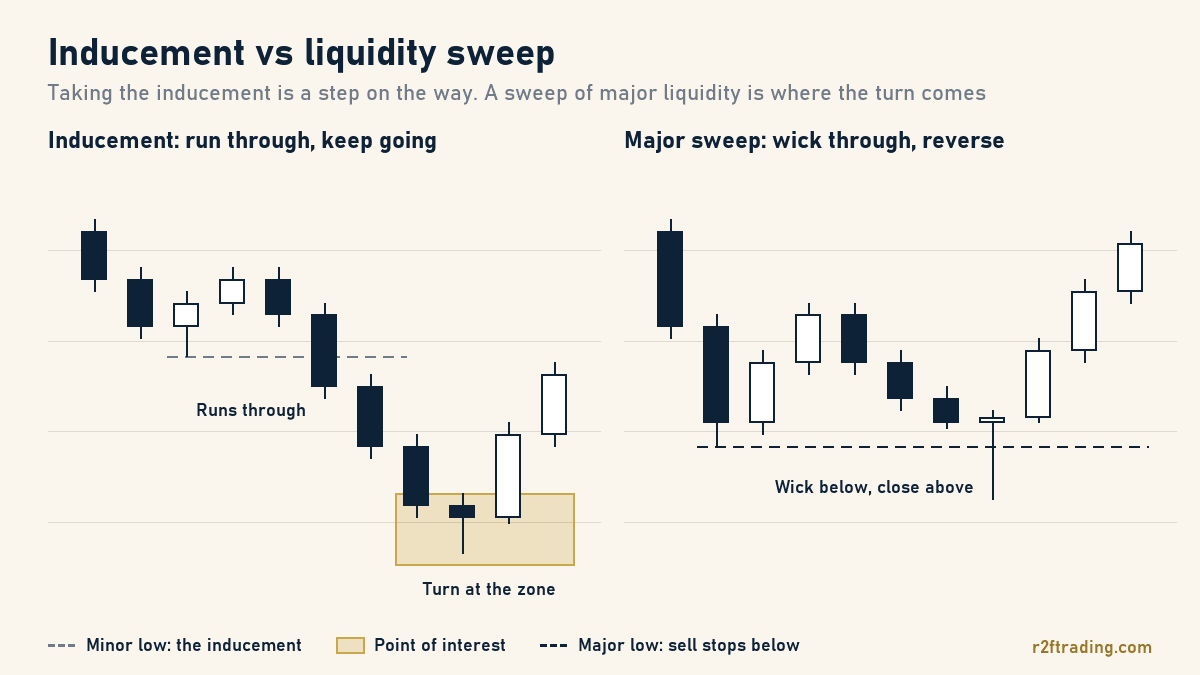
Inducement is the bait, and a liquidity sweep is the event: price running through a pool of stops. Price often sweeps the inducement itself. The difference is what you expect next:
- After the inducement is taken, price usually keeps going toward the point of interest, so fading that run means trading against the move.
- After a sweep of major liquidity at your point of interest, such as the previous day's high, traders look for the reversal: a close back inside the range and a shift in structure.
- Size matters. Inducement is usually minor, internal liquidity. The sweep that turns price usually takes external liquidity, a major high or low the whole market is watching.
How I read it: manipulation around retail patterns
On stream I call this manipulation around retail patterns. The only retail tools I expect manipulation around are trend lines and equal highs and lows, essentially support and resistance. Session highs and lows get the same treatment, because traders who got in during that session have stops there.
I set the target first. On one London session in November, my EURUSD target sat above price, at a level from the PD array matrix. On the way, price ran equal highs, pierced a trend line and got rejected. To me that was "the manipulation of trend line and equal highs", and I expected one more manipulation before the push to the target.
Trend lines work until they don't. A rejection at one on the way to my target is good news, because it builds liquidity that price can run later. As I said on one stream: "I want to see scary things happen." I take trend lines into account without trading them, and I won't short a line just because it shows resistance.
How I trade around inducement
Inducement is context and a target for me. My entries still come from candles in the direction of my bias, once price reaches my level:
- Set the bias and the target first. I work top down and mark the PD array price is drawn to. Here is how I find the daily bias.
- Mark the retail patterns in between. Trend lines, equal highs and lows, and session highs and lows are where I expect the traps.
- Let the trap happen. A spike against my bias into one of those levels is the inducement. Price is either hunting that liquidity now or building it to come back for later.
- Wait for my level, then drop a timeframe. At my point of interest I go down to the 5 or 15 minute chart and wait for a candle or small order block that confirms the move my way.
- Put the stop where the idea is wrong, beyond my point of interest and away from the obvious level the early traders used.
- Use the next inducement as a target. My first target is the low-hanging fruit. On one session my second target was "the inducement of the sell side": equal lows that retail logic sees as support. I take profit a little before levels like that, since price can turn just short of them.
How to avoid being the induced trader
- Mark your level before the session. Without one, you take whatever looks good first, and that is usually the inducement.
- Keep stops away from the obvious spot. A stop a few pips beyond equal lows, a trend line or the Asian low is the liquidity this guide is about.
- Check the scale. A tiny poke beyond equal highs takes very few stops and often just creates more equal highs.
- Watch the speed. A move that traps traders should be quick. A slow move gives them time to get out.
- Note when the news hits. I ignore the forecast and only note the release time, because news can make price reach for liquidity very fast.
Watch inducement play out live
I trade the London open live every weekday and mark these levels before price reaches them, so you can see which ones get used as bait. Times in your zone are on the live schedule.