ICT Timeframe Alignment: How to Trade Top-Down
If you've spent any time studying ICT concepts, you've probably heard the phrase 'top-down analysis' repeated like a mantra. What you hear less often is a clear, step-by-step explanation of how ICT timeframe alignment actually works in practice, which timeframes to use, in what order, and what specifically you're looking for at each level before you ever zoom in to find an entry. That's what this article is.
Key Takeaway: ICT timeframe alignment means identifying the dominant directional bias on a higher timeframe, confirming the narrative on an intermediate timeframe, and then using a lower timeframe only to execute inside that pre-confirmed context. If all three levels agree, your setup has real edge. If they don't, you don't have a setup.
Why Most Traders Get Timeframe Alignment Backwards
Here's the pattern I see constantly: a trader spots what looks like a clean order block on the 15-minute chart, gets excited, and then quickly checks the 4-hour to see if it 'agrees.' That's backwards, and it's a subtle but serious problem.
When you start on the lower timeframe and work up, you're not actually doing top-down analysis. You're rationalising a setup you've already emotionally committed to. The human brain is very good at finding confirmation for whatever it already wants to believe, and chart reading is no exception. You'll almost always be able to find something on the 4-hour that could justify your 15-minute setup if you look hard enough.
Real ICT timeframe alignment works in one direction only: higher timeframe first, lower timeframe last.
The Three-Level Framework
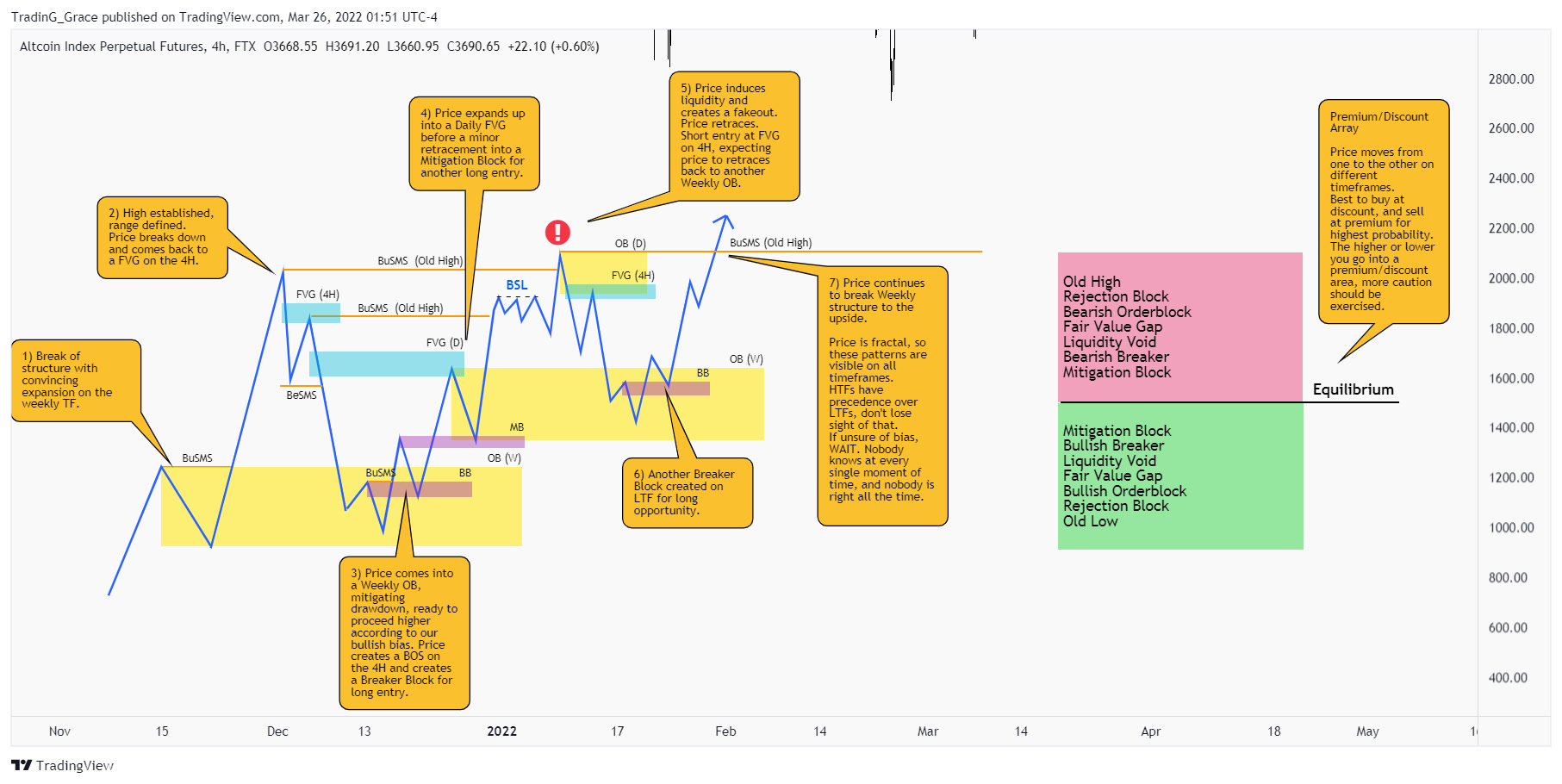
For most forex pairs and indices, I use three timeframe tiers. These aren't arbitrary. Each level has a specific job.
Tier 1 (Weekly/Daily): The Narrative
This is where you establish the macro directional bias. You're not looking for entries here. You're asking: is price in a premium or discount relative to the dealing range? Is there a clear structural shift that signals a prevailing draw on liquidity? Where is the most significant pool of liquidity sitting above or below current price? (If you want a deeper walkthrough of premium, discount and dealing ranges, this breakdown covers it thoroughly.)
The weekly sets the stage. The daily refines it. By the time you've done this level of work, you should be able to complete this sentence in one clear sentence: 'Price is currently in [premium/discount], the bias is [bullish/bearish], and the draw on liquidity is [specific level].'
If you can't complete that sentence cleanly, the narrative isn't clear enough to trade from. That's not a failure. That's the filter working.
Tier 2 (4-Hour/1-Hour): The Setup
Once you have a narrative, the intermediate timeframe is where you identify the specific setup structure. You're looking for displacement, fair value gaps, order blocks, and market structure shifts that align with the higher timeframe bias. Crucially, you're asking: is price approaching a point of interest that makes sense within the narrative I've already defined?
For example, if the daily says price is bullish and drawing toward buy-side liquidity above last week's high, you're looking on the 4-hour for a retracement into a discount area, into a demand structure, where smart money would logically re-enter long positions. Displacement is a core concept here, because without it, any order block you identify is just a candle, not a mitigation zone.
Tier 3 (15-Minute/5-Minute): The Entry
Only here do you go looking for a precise entry. You're watching for a lower timeframe market structure shift, a break of structure to the upside (in a bullish scenario), confirmation that price has actually reacted to the point of interest identified on Tier 2. This is where you define your entry candle, your stop placement, and your target.
The lower timeframe is a microscope, not a compass. It tells you when and where to get in. It does not tell you which direction to trade.
A Worked Example: EURUSD at the London Open
Picture EURUSD heading into a London session. Here's the kind of setup this framework is designed to find.
On the daily chart, price has swept sell-side liquidity below a significant swing low and displaced aggressively back above that level. That's a bullish narrative: smart money ran stops, reversed, and now the draw is on buy-side liquidity sitting above the most recent daily high. Price is in discount relative to the weekly dealing range. The narrative is clear and bullish.
Dropping to the 4-hour, there's a clear fair value gap left behind by that displacement candle. Price has pulled back into that gap, which sits in the lower quadrant of the daily range (still in discount). There's an order block at the base of the gap. The 4-hour structure has not broken to the downside since the daily reversal. The setup is defined: I want a long from this 4-hour demand zone.
Now the 15-minute. Price enters the 4-hour fair value gap during the London open window (02:00 to 05:00 New York time). After spending a few candles inside the gap, there's a sharp displacement to the upside, breaking the most recent 15-minute swing high. That's the lower timeframe market structure shift. That candle, or the first pullback after it, is the entry.
Stop goes below the swing low that formed inside the fair value gap, below the order block. That's the logical invalidation point: if price trades below the structure that confirmed the entry, the setup is wrong. The target is the buy-side liquidity sitting above the most recent daily high, the draw identified at Tier 1.
The setup has a clear reason, a defined stop, and a specific target. Every decision traces back to the original narrative. That's what alignment feels like.
The Nuance Nobody Talks About: Alignment Has a Shelf Life
Here's something that took me years to internalise. Timeframe alignment is not a static condition. It expires.
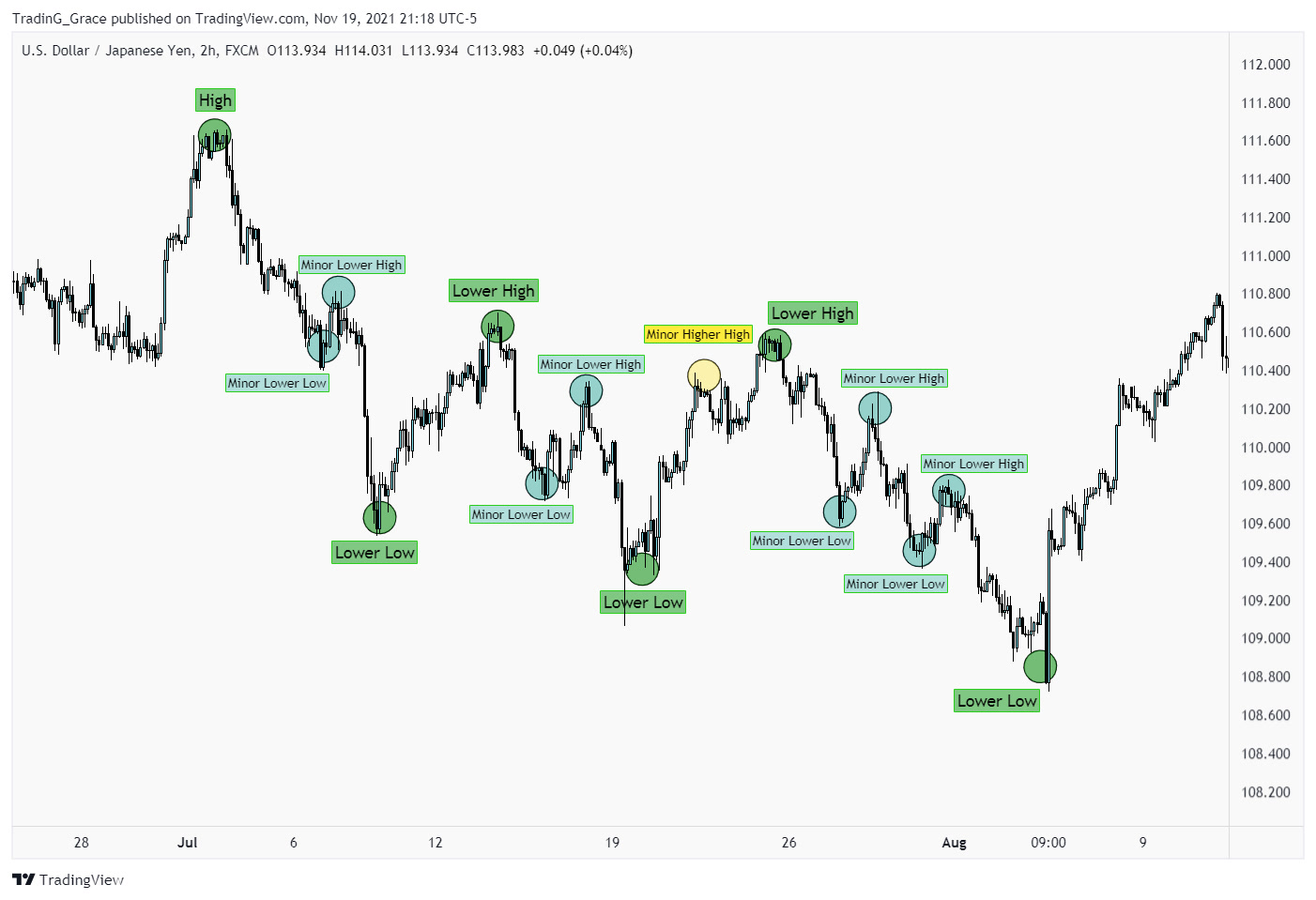
Most traders think of alignment as a checkbox: daily is bullish, 4-hour confirms, 15-minute gives entry, done. But markets move. By the time price pulls back to your 4-hour order block, the daily structure may have shifted. That gap you identified three sessions ago might have been partially or fully mitigated without you noticing. The liquidity target you're aiming for might have already been swept in a session you weren't watching.
Before every entry, I re-check the narrative from Tier 1 down. Not a quick glance. An actual re-read of the structure. This takes maybe five minutes. It has saved me from more bad trades than any other single habit.
Alignment is not something you establish once and trade off indefinitely. It needs to be re-confirmed as close to entry as practically possible.
The Trader Who Treats the 15-Minute Like a Strategy
There's a recognisable pattern in traders who've studied ICT for six to twelve months and are still struggling: they're using the 15-minute chart as their primary analytical timeframe and treating everything above it as optional context they'll check if they have time.
The setups look right. The order blocks are there. The fair value gaps are there. The entries are technically valid. But the win rate doesn't reflect the effort, and the losses feel 'random.'
They're almost never random. What's usually happening is that the 15-minute setup is technically correct but structurally misaligned. Price is entering an order block that sits in premium on the daily, so even though the 15-minute says buy, the higher timeframe narrative says price should be distributing, not accumulating. The 15-minute setup is a counter-trend scalp dressed up to look like a swing trade.
The fix isn't a better entry technique. It's doing the top-down work first and refusing to open the lower timeframe until the higher timeframe work is done. If that sounds simple, it is. Following through on it is the hard part, which is a conversation worth having in more depth here.
A Practical Checklist Before Any Entry
Here's the exact sequence I run, in order, before clicking the buy or sell button.
-
Weekly/Daily narrative check. What is the prevailing bias? Where is the draw on liquidity? Is price in premium or discount? Write it down in one sentence.
-
Daily/4-hour setup identification. Is there a valid point of interest (order block, fair value gap, breaker) aligned with the narrative? Has price reached or is it approaching that level?
-
Lower timeframe confirmation. Has there been a displacement and a lower timeframe market structure shift at the point of interest? Or am I anticipating one that hasn't happened yet?
-
Stop placement check. Is my stop below/above the logical invalidation point for this specific setup structure, not just a fixed pip value? (If you need help sizing your position around that stop, the risk calculator handles it quickly.)
-
Target verification. Is my target still valid? Has the liquidity I'm targeting already been swept since I first identified it?
If any of these five steps produces an unclear answer, the trade doesn't happen. That's not indecision. That's the framework doing its job.
One More Thing Worth Saying
I used to think that having a higher timeframe bias meant I could be relaxed about lower timeframe structure. If the daily is bullish, surely a long anywhere near support will work eventually? That thinking is expensive. The 'eventually' in that sentence has blown a lot of people's risk tolerance wide open. The ICT 2022 model addresses this directly by anchoring entry precision to specific time windows and structure conditions, not just directional bias. That breakdown is worth reading if you want to see how the model operationalises alignment in practice.
Timeframe alignment is not about finding more setups. It's about filtering down to fewer setups with better reasons behind them. The traders who've been doing this long enough to have an edge are almost universally taking fewer trades than they did in year one, not more.
If you want structured guidance working through this process for your own trading, you can see what coaching looks like at R2F. There are three tiers depending on how much support and accountability you want. Or if you'd rather talk through where you are first, book a free discovery call and we can figure out from there what actually makes sense for your situation.
Harvest Wright
ICT Trading Coach · 10+ Years Experience
Harvest specializes in ICT methodology and has helped traders pass prop firm challenges, develop consistent strategies, and build the psychology needed for long-term profitability.
Book a Free Discovery Call →Take Your Trading to the Next Level
Get personalized 1-on-1 ICT coaching with Harvest Wright. Free discovery call, no commitment.
Book a Free Discovery CallFree ICT Funded-Trader Playbook
The setups, the pre-trade checklist, and the risk rules I use. Get it free.