FTMO Daily Loss Limit: How Traders Breach It
On a 50k FTMO 2-Step account, the maximum daily loss is $2,500. When I finished my Verification, the target was also $2,500, because both are 5% of the starting balance. The most you can lose in one day is as big as the whole second phase, and going past it ends the attempt.
This post explains how FTMO calculates the daily loss as of October 2026, using the numbers on its Trading Objectives page, and the ways traders breach it by accident. FTMO updates its rules, so check the current version on its site before you buy.
Disclosure: FTMO is the firm I use, and I'm an FTMO affiliate. If you buy a challenge through the links on my FTMO page, I earn a commission at no extra cost to you.
Key Takeaway: FTMO resets your daily floor at midnight Central European time. The floor is your balance at that moment minus 5% of your starting balance on the 2-Step, or 3% on the 1-Step. Your equity, open trades included, has to stay above it until the next reset, or the account fails.
How FTMO calculates the maximum daily loss
Three numbers go into it:
- Midnight balance: your balance at 00:00 CE(S)T, which is midnight Central European time. On day one, FTMO uses your starting balance.
- Allowance: 5% of your starting balance on the 2-Step, or 3% on the 1-Step. It never changes size.
- Equity: your balance plus or minus open trades and swaps, minus commissions.
The day's floor is the midnight balance minus the allowance. Your equity has to stay above that floor until the next midnight, when FTMO works it out again.
FTMO's example on a $100,000 2-Step account:
- Day 1: $100,000 minus $5,000 gives a floor of $95,000.
- After a $102,000 balance at midnight, the day 2 floor is $97,000.
- After a $101,000 balance at midnight, the day 3 floor is $96,000.
On a 50k 2-Step account the allowance is $2,500, so the day one floor is $47,500.
Two things follow from that formula. Profit you close during the day adds room until midnight, because your equity rises while the floor stays put. Then at midnight the floor moves up to your new balance minus 5%, and with no open trades the room goes back to $2,500 on a 50k account. However well your week goes, the daily allowance stays the same.
Five ways traders breach it without meaning to
1. Counting closed trades only
The rule watches equity. Say you're on a 50k account, you've lost $1,500 on closed trades today, and an open trade is $1,100 down. You're $2,600 down on the day and the account is breached. It makes no difference that the open trade might have recovered. Once equity drops below the floor, FTMO closes your trades and the attempt is over.
Swaps and commissions count as well. They're small, and they can be the last few dollars when you're close to the line.
2. Holding a losing trade past midnight
At midnight FTMO sets the new floor from your balance, and your balance leaves out open trades. Carry a trade into the new day that's $1,000 down on a 50k account, and the floor still sits $2,500 below your balance. Your equity starts the day $1,000 closer to it, so you have $1,500 of room before you've placed a new trade.
In London the reset is at 11 p.m. Work out what time it is where you live, and decide in advance what you'll do with open trades before it.
3. Stacking trades on one currency
Long EURUSD, long GBPUSD and short USDCHF look like three trades. All three are bets against the dollar. If the dollar jumps, they lose together, and three small risks add up to one large one.
You can hear me think this way in the USDCAD video. Once I expected USDCAD to keep falling, my next thought was what a weaker dollar meant for EURUSD and GBPUSD. That's a good way to find trades, and it's also a reminder that taking all of them at once stacks the risk on one idea.
4. News you didn't see coming
Scheduled releases are on the calendar, but some of the biggest moves come from news nobody scheduled.
USDCAD had one of those before my trade. As I explain in the video, the move came from tariff news on Canada that broke late in the US evening, and USDCAD dropped sharply. A lot of the people who trade that pair were asleep, so anyone holding a big long woke up to a very different account.
During the FTMO Challenge and the Verification you're allowed to trade and hold through news. That freedom comes with gap and slippage risk. A stop loss is an order, and in a fast market it can fill at a worse price than the one you set. Size your trades as if that can happen.
5. Trying to win back the first loss
The first loss of the day is part of trading. The trouble usually starts with the second trade, taken bigger to win the first one back. A hard stop after two losses, or a fixed number of trades per day, takes that decision away from you when you're least able to make it well.
How I managed the USDCAD trade that helped finish my Verification
The full breakdown is on YouTube: The trade that PASSED a 50k FTMO Challenge. Below is how it lines up with the daily loss rule.
The read
Price had already pierced the buy-side liquidity above, and there was sell-side liquidity below. On the higher timeframes, price had traded into a yearly gap and a yearly order block. On the monthly chart it had made equal lows and a trend line it kept testing. I called that trend line a big magnet and expected price to come down and attack it. The 50% level of the range went on the chart too, marked as equilibrium, or fair value (more on that in premium and discount).
I didn't need a giant target. The level at the far end of the move was about 2,000 pips away, and I said in the video that I'd only aim for something like that with a very small position.
The plan and the stop
The tariff news had already pushed USDCAD down before I planned the trade. Just before the news, price had pumped up into a high, and I read that pump as a manipulation that pulled traders into longs. There was still sell-side liquidity below the low where the move started, so my plan was a continuation short.
The simple stop was above that high. I called it a lazy position: the stop is wide, so the size has to be smaller for the same risk. A tighter stop with more size would have meant waiting for a pullback that might never come.
That's the part that matters for the daily loss. The stop goes where the idea is wrong, and the size comes from the stop. Sized that way, a wide stop costs no more than a tight one when it's hit.
What happened
Price consolidated, came back up into a 4-hour inversion gap, ran the liquidity at a trend line and some equal highs, and then fell quickly. That trade and a USDCHF trade took my 50k account past the 5% Verification target of $2,500. I had a little drawdown on the way. After passing, I had to sign the contract with FTMO and wait a few days for the FTMO Account.
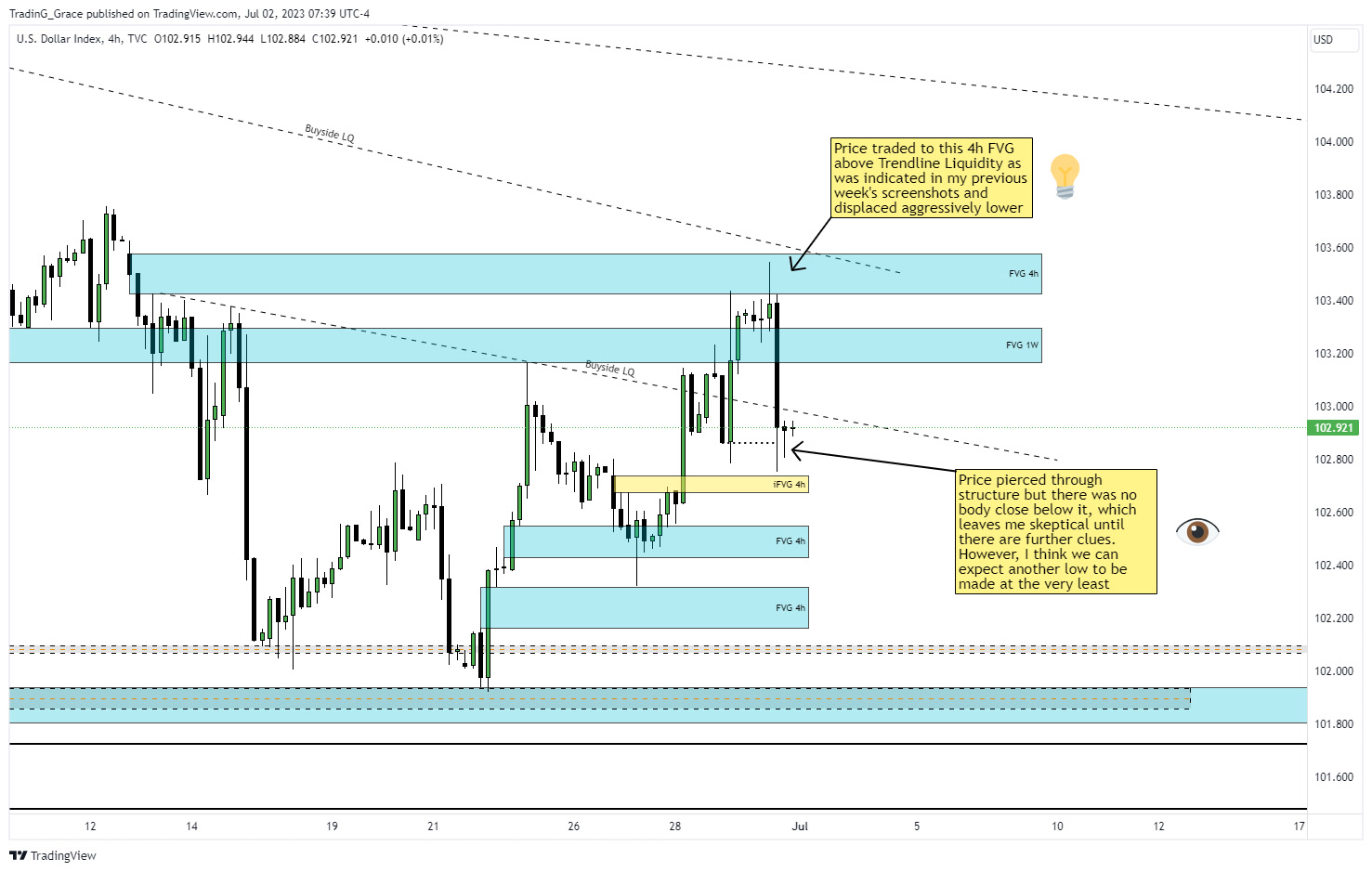
The chart below shows the same pieces on a different market, the dollar index on the 4-hour: 4-hour gaps, an inversion gap and trendline liquidity. It's an example of the idea, separate from the USDCAD trade.
A daily loss plan you can copy
- Set your own daily stop. Pick a number inside FTMO's limit, such as half of it: $1,250 on a 50k 2-Step account. When you reach it, you're done for the day. The gap between your stop and FTMO's covers slippage and bad fills.
- Work out risk per trade from that stop. Decide how many losing trades in a row you want to survive in one day, then divide. With a $1,250 daily stop and room for three losses, the most you'd risk per trade is about $415.
- Count open trades as already stopped out. Before you add a trade, add up the risk on everything open as if every stop gets hit. If that total plus today's closed losses goes past your daily stop, skip the trade.
- Decide what happens at midnight. Close or reduce open trades before 00:00 CE(S)T, or accept that any open loss comes with you into the new day.
- Check the calendar each morning. FTMO marks restricted events in its economic calendar. You can trade them in the evaluation, and you should know they're coming.
- Stop after two losses. Two losing trades in a day is enough. Close the platform and come back tomorrow.
- Rehearse on the Free Trial. FTMO's Free Trial uses the 2-Step rules with a lower profit target and one phase. It doesn't count toward a challenge, and it shows you how your trading sits against the daily floor before you pay for one.
For the lot-size side of this, see the position sizing cheat sheet for funded traders and the position sizing guide. How to pass a funded challenge without blowing it covers the behavior side, and the full rule list is in FTMO Challenge rules explained.
If you want a second pair of eyes on your plan, that's what my 1-on-1 coaching is for. The free ICT Funded-Trader Playbook has my pre-trade checklist and risk rules.
FTMO daily loss: FAQ
How is the FTMO maximum daily loss calculated?
As of October 2026, FTMO takes your balance at midnight Central European time and subtracts 5% of your starting balance on the 2-Step, or 3% on the 1-Step. Your equity has to stay above that number until the next midnight. On a $100,000 2-Step account, the day one floor is $95,000.
Does the FTMO daily loss include floating losses?
It does. FTMO measures it on equity, which is your balance plus or minus open trades and swaps, minus commissions. An open trade can breach the account before you close it.
What time does the FTMO daily loss reset?
At 00:00 CE(S)T, which is midnight Central European time and 11 p.m. in London. A trade you hold past that time carries its open loss into the new day.
Is the FTMO daily loss based on balance or equity?
Both play a part. The floor is set from your balance at midnight, and your equity has to stay above it during the day.
Does a winning day give me a bigger daily loss allowance?
No. The allowance is always 5% of the starting balance on the 2-Step. Profit you close during the day adds room until midnight, and then the floor moves up to your new balance minus 5%, so the allowance stays the same size.
What happens if I hit the FTMO daily loss limit?
The platform closes all your open trades and the account fails. On the 2-Step this rule applies in the FTMO Challenge, the Verification and the FTMO Account.
Risk note
Trading carries substantial risk, and most traders lose money. Passing an FTMO Challenge is never guaranteed, and nothing here is financial advice. FTMO can change its rules, so check the current terms on its site before you buy.
Harvest Wright
ICT Trading Coach · 10+ Years Experience
Harvest specializes in ICT methodology and has helped traders pass prop firm challenges, develop consistent strategies, and build the psychology needed for long-term profitability.
Book a Free Discovery Call →Ready to Get Funded?
1-on-1 ICT coaching built around prop firm rules, from a trader who has passed an FTMO Challenge.
Book a Free Discovery CallFree ICT Funded-Trader Playbook
The setups, the pre-trade checklist, and the risk rules I use. Get it free.