FTMO Challenge Rules Explained
I passed FTMO's 2-Step evaluation on a 50k account. One of the two trades that finished my Verification was a USDCAD short, and I'll come back to it further down. The rules come first, because a challenge tests your risk control as much as your entries.
Everything below comes from FTMO's Trading Objectives page and FAQ, as of October 2026. FTMO updates its terms, so check its site for the current version before you buy.
Disclosure: I'm an FTMO affiliate. If you buy a challenge through the links on my FTMO page, I earn a commission at no extra cost to you.
Key Takeaway: On FTMO's 2-Step you need a 10% profit in the FTMO Challenge and 5% in the Verification, with at least 4 trading days in each phase and no time limit. Your equity, open trades included, can't fall more than 5% of the starting balance below the day's midnight balance, or more than 10% below the starting balance.
The 2-Step rules at a glance
The 2-Step runs in three stages: the FTMO Challenge, the Verification, and then the FTMO Account. As of October 2026 the rules are:
- Profit target: 10% of the starting balance in the FTMO Challenge and 5% in the Verification. The FTMO Account has no profit target.
- Maximum daily loss: 5% of the starting balance. Open trades count, and the limit resets at midnight Central European time.
- Maximum loss: 10% of the starting balance. This floor is fixed and doesn't move.
- Minimum trading days: 4 in the FTMO Challenge and 4 in the Verification.
- Time limit: none.
- News and weekends: no restriction during the Challenge and the Verification. Restrictions start on a standard FTMO Account.
On a 50k account like mine, those rules come out as:
- FTMO Challenge target: $5,000
- Verification target: $2,500
- Maximum daily loss: $2,500 below your balance at midnight
- Maximum loss: equity can never fall below $45,000
The Verification target and the daily loss are both 5%. So on the 2-Step, the most you're allowed to lose in a single day equals everything the second phase asks you to make.
Profit target
You need a 10% gain in the FTMO Challenge and a 5% gain in the Verification, both measured from the starting balance. On a $100,000 account that's $10,000, then $5,000.
For my Verification the sum was easy: 5% of 50k is $2,500. The USDCAD short and a USDCHF trade took the account past it. I had a little drawdown along the way, which is normal, and the two loss rules below decide whether drawdown like that is survivable.
The FTMO Account has no profit target. Once you're there, the job is to stay inside the loss limits.
Maximum daily loss
This is the rule I'd learn first, so it gets the most space here.
FTMO works out your daily floor at midnight Central European time, which it writes as 00:00 CE(S)T. The floor is your balance at midnight minus 5% of your starting balance, and your equity has to stay above it until the next midnight. Equity is your balance plus or minus open trades and swaps, minus commissions.
FTMO's own example on a $100,000 account:
- Day 1: the floor is $95,000.
- Day 1 ends with a $102,000 balance, so the day 2 floor is $97,000.
- Day 2 ends with a $101,000 balance, so the day 3 floor is $96,000.
Three details catch people out:
- Open trades count. If today's closed losses plus a floating loss go past the limit at any moment, the account is breached, even if the trade would have come back.
- The allowance is a fixed amount. It's always 5% of the starting balance, measured from your balance at midnight. A winning day lifts the next day's floor along with your balance, so the allowance never grows with the account.
- Midnight is the reset. The new floor comes from your balance, and your balance leaves out open trades. Hold a losing trade past midnight and its open loss eats into the new day's allowance.
In London the reset happens at 11 p.m. I go through the ways traders breach this rule, with worked examples, in FTMO daily loss limit: how traders breach it.
Maximum loss
On the 2-Step your equity can never fall below 90% of the starting balance. On $100,000 the floor is $90,000, and it stays there however much you make. On my 50k it was $45,000.
Because the floor is fixed, profit buys you room. If you're up $3,000 on a 50k account, you're $8,000 above the floor, and the daily loss becomes the tighter of the two limits.
The 1-Step handles this differently, with a floor that trails your best end-of-day balance. I compare the two in FTMO 1-Step vs 2-Step: how to choose.
Minimum trading days
You need at least 4 trading days in the FTMO Challenge and another 4 in the Verification. A trading day is any day, midnight to midnight Central European time, on which you open at least one position. The days don't have to be in a row.
FTMO gives its own example: opening trades on only three separate days doesn't meet the rule, whatever your profit.
If you hit the target early, you still need the remaining days. Keep the risk small on those days, because a big loss can still breach the account. The FTMO Account has no minimum.
Time limit
As of October 2026 there's no time limit on the 2-Step or the 1-Step. FTMO's FAQ says the quickest the 2-Step can be done is 8 trading days, 4 in each phase.
No deadline also means there's no reason to force a trade on a day that doesn't suit your setup.
News trading
You can trade news during the FTMO Challenge and the Verification.
A standard FTMO Account has a restriction. FTMO blocks order execution for 2 minutes before and 2 minutes after selected news releases, on the instruments tied to that release. During US Non-Farm Payrolls, for example, you can still trade EURGBP. The block covers stop losses, take profits and pending orders that would trigger in the window, and trades opened more than 2 minutes before the release can stay open. FTMO marks the restricted events in its economic calendar, and Swing accounts are exempt.
Holding trades overnight and over the weekend
During the Challenge and the Verification you can hold trades overnight and over the weekend.
On a standard FTMO Account you can't hold positions through market breaks longer than 2 hours, and the weekend is one of those. A Swing account can. The trade-off is leverage: up to 1:100 on a standard account and up to 1:30 on Swing. Swing is only offered on the 2-Step.
What happens if you break a rule
If your equity hits the maximum daily loss or the maximum loss, the platform closes all your open trades and the account fails.
The minimum trading days rule works differently. You can't break it, and until you've met it you keep trading.
All trading at FTMO runs on simulated capital, including on the FTMO Account. If you pass and keep to the rules there, you become eligible for a Reward.
The 1-Step in brief
FTMO also sells a 1-Step Challenge, with one phase and no Verification. As of October 2026 it has:
- a 10% profit target
- a 3% maximum daily loss
- a 10% maximum loss that trails up with your highest end-of-day balance
- a Consistency rule, which says your best day can't be more than 50% of your total profit
- no separate minimum trading days rule, and no time limit
Whether it suits you depends mostly on how big your losing days get. I go through that in FTMO 1-Step vs 2-Step.
Turning the rules into a plan
The rules give you two distances to watch every day: how far you are from the daily floor, and how far you are from the maximum loss. Before the first trade, I'd write down four things.
- A personal daily stop. Set it well inside FTMO's 5%. On a 50k account FTMO's limit is $2,500, and a stop at about half of that leaves room for a bad fill.
- Risk per trade. Work it out from that daily stop: decide how many losses in a row you want to survive in one day, then divide.
- A midnight plan. Decide what you'll do with open trades before 00:00 CE(S)T.
- A two-loss rule. Decide what you'll do after two losing trades in a day.
The free ICT Funded-Trader Playbook has my pre-trade checklist and the risk rules I follow. For the lot-size math, see the position sizing cheat sheet for funded traders and the prop firm challenge risk management guide. If you'd like someone to check your plan against your own trading, that's what my 1-on-1 coaching is for.
The USDCAD trade
The trade I mentioned at the start is on my YouTube channel: The trade that PASSED a 50k FTMO Challenge.
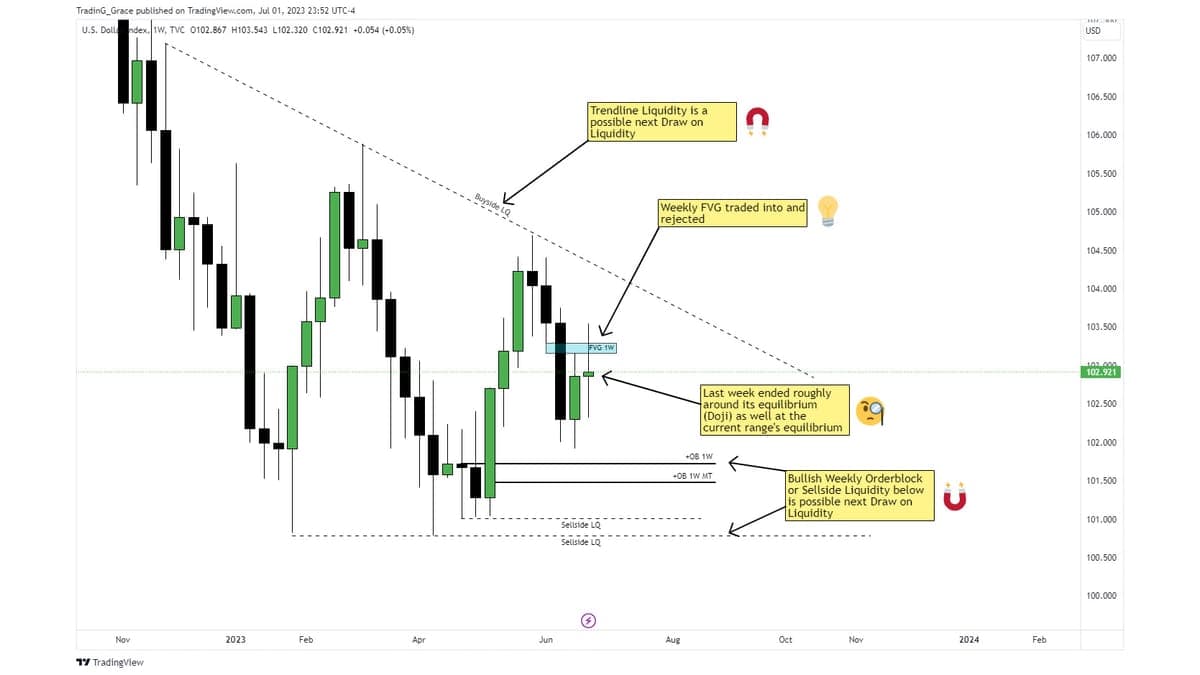
Buy-side liquidity above price had already been taken, and sell-side liquidity sat below. On the monthly chart there were equal lows and a trend line that price kept testing, which I called a big magnet. My read was a continuation short, with the stop above a high I didn't expect to break. That trade and a USDCHF trade took the account past the $2,500 Verification target. I go through how I managed it in the daily loss guide.
FTMO Challenge rules: FAQ
What are the FTMO Challenge rules?
As of October 2026, the 2-Step needs a 10% profit in the FTMO Challenge and 5% in the Verification, with at least 4 trading days in each phase. The maximum daily loss is 5% of the starting balance and the maximum loss is 10%, both measured on equity, and there's no time limit. Check ftmo.com for the current rules before you buy.
Is there a time limit on the FTMO Challenge?
No. As of October 2026, FTMO's FAQ says there is no maximum time limit on the 2-Step or the 1-Step Challenge.
How many trading days do you need to pass FTMO?
On the 2-Step you need at least 4 trading days in the FTMO Challenge and 4 in the Verification. A trading day is one on which you open at least one position, and the days don't need to be in a row.
Does the FTMO daily loss include open trades?
It does. The limit is measured on equity, which is your balance plus or minus open trades and swaps, minus commissions. A floating loss can breach the account before you close anything.
Can you trade news during the FTMO Challenge?
Yes. The news restriction doesn't apply in the FTMO Challenge or the Verification. On a standard FTMO Account, FTMO blocks order execution for 2 minutes either side of selected releases, which it marks in its economic calendar. Swing accounts are exempt.
Can you hold trades over the weekend in the FTMO Challenge?
During the Challenge and the Verification you can. On a standard FTMO Account you can't hold positions through market breaks longer than 2 hours, which includes the weekend. Swing accounts can, with lower leverage.
What happens if you break an FTMO rule?
If your equity hits the maximum daily loss or the maximum loss, FTMO closes your open trades and the account fails. The minimum trading days rule can't be broken, and you keep trading until you meet it.
Risk note
Trading carries substantial risk, and most traders lose money. Passing an FTMO Challenge is never guaranteed, and nothing in this post is financial advice. FTMO can change its rules, so read the current terms on its site before you pay for an evaluation.
Harvest Wright
ICT Trading Coach · 10+ Years Experience
Harvest specializes in ICT methodology and has helped traders pass prop firm challenges, develop consistent strategies, and build the psychology needed for long-term profitability.
Book a Free Discovery Call →Ready to Get Funded?
1-on-1 ICT coaching built around prop firm rules, from a trader who has passed an FTMO Challenge.
Book a Free Discovery CallFree ICT Funded-Trader Playbook
The setups, the pre-trade checklist, and the risk rules I use. Get it free.