GDP Shock? How Smart Money Reacts vs. You
Every GDP release day, the same scene plays out across trading desks and Discord servers worldwide. The number drops. Price spikes. Retail traders scramble, some chasing the initial move, some waiting for a "retest," plenty getting wrecked by 10:30 AM. Meanwhile, if you watch the tape closely using smart money concepts, you start to notice something strange: the big move often started before the number hit, or it reversed hard into a level that had nothing to do with the headline figure. After 10+ years of trading, I think most traders are solving the wrong puzzle.
Key Takeaway: In my view, smart money cares less about the GDP headline and more about the narrative shift triggered by prior quarter revisions, which are buried in the report's fine print. The real edge on GDP day is knowing which number to ignore and which one just changed the institutional thesis.
The Anchoring Trap Nobody in ICT Communities Talks About
Here's the specific cognitive bias at play: anchoring. When the GDP report drops, your brain locks onto the first number it sees, the headline print. Say GDP comes in a little above consensus. Your brain immediately files that as "better than expected, dollar bullish." Done. Decision made. You're already reaching for the buy button on DXY-correlated pairs.
But here's what you can miss in the three seconds it takes to read that headline: say the prior quarter was revised down by more than the size of the beat.
Now the headline beat looks impressive in isolation, but in context the trend just got weaker. The U.S. Bureau of Economic Analysis puts these revisions in the same report, same timestamp, but further down the page, and a lot of retail traders never get there before they've already clicked buy.
Big desks have scenarios prepared for both the headline and the revisions. When the release lands, they're executing a plan, not reacting to a number.
You're reacting. They're confirming.
That gap in process is the entire ballgame.
A Worked Example
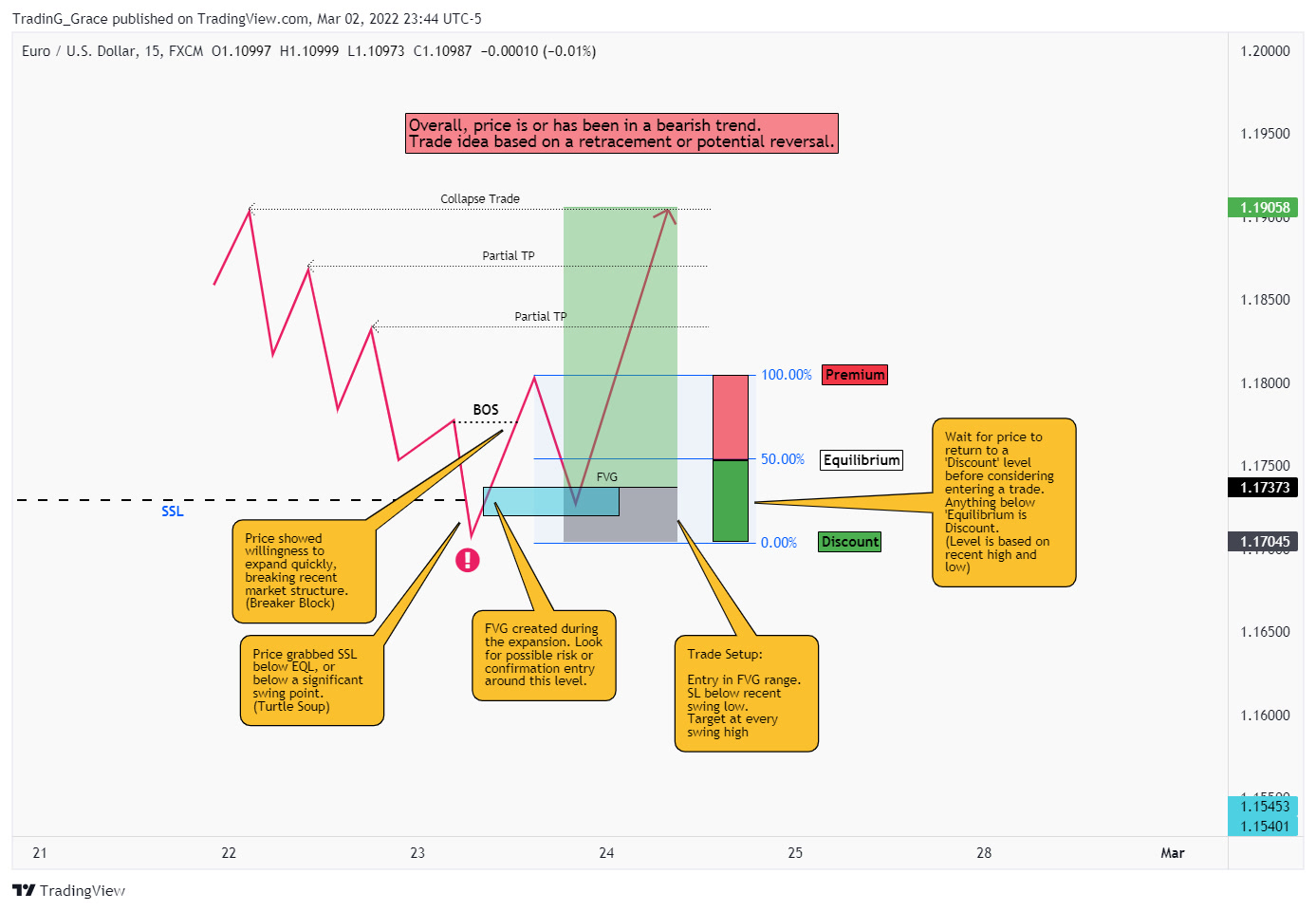
Picture GBPUSD on the 15-minute chart around the New York open on GDP day. Pre-release, price has swept the Asian session highs, a clean liquidity grab above a short-term swing, and returned back below a 4-hour bearish order block.
The number drops and price spikes up through the OB. Traders chase the pop. That first candle closes as a full-body bull candle. Looks clean. Looks impulsive.
The disciplined move is to wait and read the actual BEA release. Say the prior quarter was revised down and the inflation data in the same report came in hot. That's a messier signal than the headline suggests. The headline can be technically accurate and misleading at the same time.
If price then falls back into the 4-hour OB and shows bearish displacement on the lower timeframe, that's the setup. The entry is the retest of the OB, the stop goes above the spike high because a new high means the move was real, and the target is the daily FVG below, where the sell-side liquidity sits. The entry reason isn't the GDP number. It's the structure, with the fuller read of the report as context.
That's smart money concepts applied to a macro release. Not indicator stacking on the headline.
The "Confirmation Junkie" Archetype
There's a specific type of trader I see get absolutely destroyed on GDP days. Call them the Confirmation Junkie.
This trader has actually done the work. They've watched the ICT content, they understand fair value gaps, they can draw order blocks with precision. Their technical analysis before the release is genuinely good, they've identified the premium/discount levels, they know where liquidity sits, they've marked the dealing range. And then the GDP number drops, and they immediately look for technical setups that confirm the headline narrative.
Headline comes in bearish for DXY? They hunt for bearish FVGs and bearish OBs. Every structure they see now looks like confirmation of the macro move. They're not reading price, they're reading price through the filter of a number they've already anchored to.
The brutal irony: their technical analysis was correct before the news. They had the right levels. They just let a headline override the structure that was already telling the story.
Smart money concepts work precisely because they strip narrative and focus on where price has to go to collect liquidity. A GDP miss doesn't move that Asian session low. The institutional order flow that was already building doesn't suddenly evaporate because a number printed 0.3% off expectations. But the Confirmation Junkie abandons the structure they spent two hours building and chases the spike instead.
I used to do this exact thing. In my earlier years, I'd spend an hour marking up a chart, then a news event would hit and I'd completely discard my analysis in favor of "trading the news." The result was entries in premium on emotional momentum, followed by stops and confusion. The chart I'd marked up beforehand was right. I just stopped trusting it the moment a headline gave me something more "certain" to react to.
Smart Money vs. Retail: A Direct Comparison
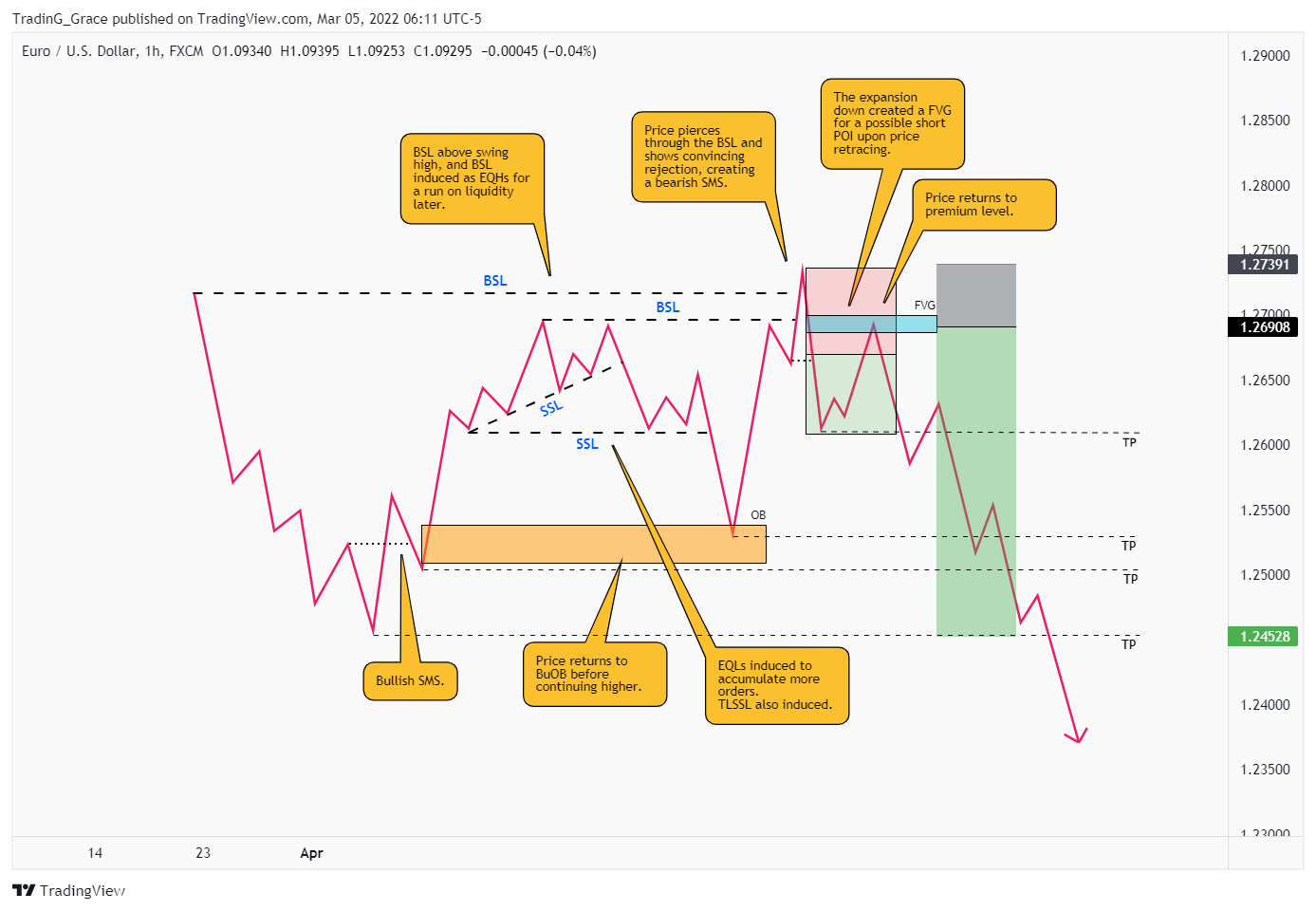
| | Retail Trader on GDP Day | Smart Money / Institutional Positioning | |---|---|---| | Primary focus | Headline GDP print vs. consensus | Prior quarter revision + trend change | | Timing | Reacts after release | Positioned days/weeks before, confirms on release | | Data sources | Financial news ticker, Twitter/X | Full BEA report, PCE deflator, employment cost data in same release | | Decision framework | "Better/worse than expected" binary | Narrative shift assessment, does this change the multi-quarter thesis? | | Execution style | Chase the spike, enter at extension | Distribute into retail momentum, or fade the emotional overshoot | | Stop placement awareness | Placed at nearest swing, easily swept | Already knows where retail stops cluster; targets them on the spike |
This isn't a cynical take. It's just mechanics. If you understand that institutions need liquidity to fill large orders, then a GDP spike that drives retail traders into chasing long positions has just created the sell-side liquidity institutions need to offload. The spike isn't the trade. The spike is the fuel depot they're pulling up to.
For a deeper breakdown of how liquidity raids function around news events, the April 2026 earnings season liquidity raids piece covers the mechanics in detail, and the pattern on GDP day is structurally similar.
The Pre-Release Framework I Actually Use
Here's exactly how to approach a GDP release without getting trapped by the headline anchor. This is practical, not theoretical.
Step 1, Mark your chart the night before. Identify the weekly and daily PD arrays. Where are the premium and discount zones? Where does liquidity rest above and below? Do this with zero reference to what GDP is expected to print. Your structure should stand alone.
Step 2, Set a 30-minute news blackout rule. After the release, no entries for 30 minutes. Yes, you'll miss the initial spike. You'll also miss getting liquidated on a fake-out. The real institutional re-positioning happens after the headline reaction exhausts itself. That first candle is often noise.
Step 3, Read the actual report, not the ticker. Open the BEA GDP release directly. Two specific numbers matter: (a) the current quarter print vs. consensus, and (b) the prior quarter revision. If the prior revision is big compared to the headline surprise, it can change the narrative regardless of what the headline print says.
Step 4, Assess narrative shift, not beat/miss. Ask: does this print change the multi-quarter growth trajectory, or does it just slightly beat a number that was already baked into price? A small beat on a downward-revised trend can be bearish. A small miss following an upward-revised trend may actually be bullish if positioning was already de-risked.
Step 5, Return to your pre-marked structure. After the 30-minute window, price should be settling. Does it return to your discount zone or your premium zone? Is it respecting the OB you marked last night? If the structure is holding, the trade is still valid, now you have the macro context confirming or invalidating the thesis, rather than the other way around.
This framework doesn't require you to be faster than algos. It requires you to be smarter about which data point actually matters. That's the actual edge in applying smart money concepts to high-impact macro releases. For a framework on handling news volatility in ranging conditions, the premium/discount arrays piece walks through the same structural approach in a different context.
And if you want to see how this mental framework applies to shifting market structure, the Q2 2026 market structure shifts breakdown is worth reading alongside this one. A lot of what trips traders up comes back to the same anchoring problem, just in a different disguise.
The Number You Should Ignore Is the One on Your Screen
Here's the contrarian truth that a decade of watching these releases has drilled into me: the most dangerous number in a GDP report is the one that gets broadcast first. Not because it's wrong, but because it's incomplete, and your brain treats it as the whole story.
A lot of retail traders lose money on GDP day even with decent technical analysis. They lose because they're solving a speed problem that doesn't exist (trying to react faster to the headline) instead of solving an information-depth problem that does (understanding which part of the report just changed the institutional narrative).
Smart money concepts, applied properly, pull you out of the reaction loop entirely. Structure is structure. Liquidity is liquidity. A GDP number doesn't move where sell-stops have been accumulating for three days. It just determines which direction the big players use to collect them.
Know that. Stay in the structure. Read the revision.
If you want to work through how to apply this kind of thinking systematically, not just on GDP days but across the full macro calendar, the coaching plans page has details on what each level covers. The difference between the Lite and Full Mentorship tracks comes down to how deep you want to go on macro context within the ICT framework. Or if you'd rather figure out whether it's the right fit first, book a free discovery call and we can talk through where you currently break down on news days specifically.
Harvest Wright
ICT Trading Coach · 10+ Years Experience
Harvest specializes in ICT methodology and has helped traders pass prop firm challenges, develop consistent strategies, and build the psychology needed for long-term profitability.
Book a Free Discovery Call →Master Your Trading Psychology
Psychology is a huge part of trading. Our coaching includes dedicated psychology sessions.
See Coaching PlansFree ICT Funded-Trader Playbook
The setups, the pre-trade checklist, and the risk rules I use. Get it free.