
The Revenge Trade Loop: How to Break It
Every trader who has blown a funded account has a version of the same story. One bad trade. Then another. Then a position three times their normal size. Then a max drawdown breach they can't explain when they review the screen recording the next morning. That's revenge trading, and if you've been told the solution is to 'just take a break,' you've been given advice that completely misses why the loop starts in the first place.
Key Takeaway: Revenge trading isn't driven by anger, it's driven by shame. Specifically, the shame that comes from a high-conviction model failing you. Until you address that shame response neurologically, no amount of willpower or 'step away from the desk' advice will stop the loop from repeating.
Why Willpower Is the Wrong Tool Entirely
Here's the part most trading content skips: when you're mid-loop, you're not operating from your prefrontal cortex. You're not making decisions. You're in an amygdala-driven threat response, the same system that controls fight-or-flight, and the 'threat' your brain has registered isn't a losing trade. It's a threat to your identity.
This is why revenge trading feels so different from other emotional reactions. You're not actually angry at the market. You're ashamed of yourself. And the brain's immediate prescription for shame is action, fast, urgent, compensatory action that proves the original loss was a fluke.
Psychologists often draw a line between shame and guilt: guilt says 'I did something bad,' shame says 'I am bad.' Guilt is recoverable. Shame is existential. And existential threats produce irrational, self-protective behavior, in our case, oversized entries with no plan, chased into premium, on pairs that weren't even on our watchlist.
The loop looks exactly like this:
Loss → Shame → Urgency → Oversize → Loss → More Shame
And it compounds. Because every subsequent loss adds more shame, which increases the urgency to 'fix it,' which leads to worse decisions. By the time most traders hit max drawdown, they've often placed several trades in the same session, each one worse than the last.
Why ICT Traders Are Specifically More Vulnerable
This is the nuance almost no one in the ICT community talks about, and it's important.
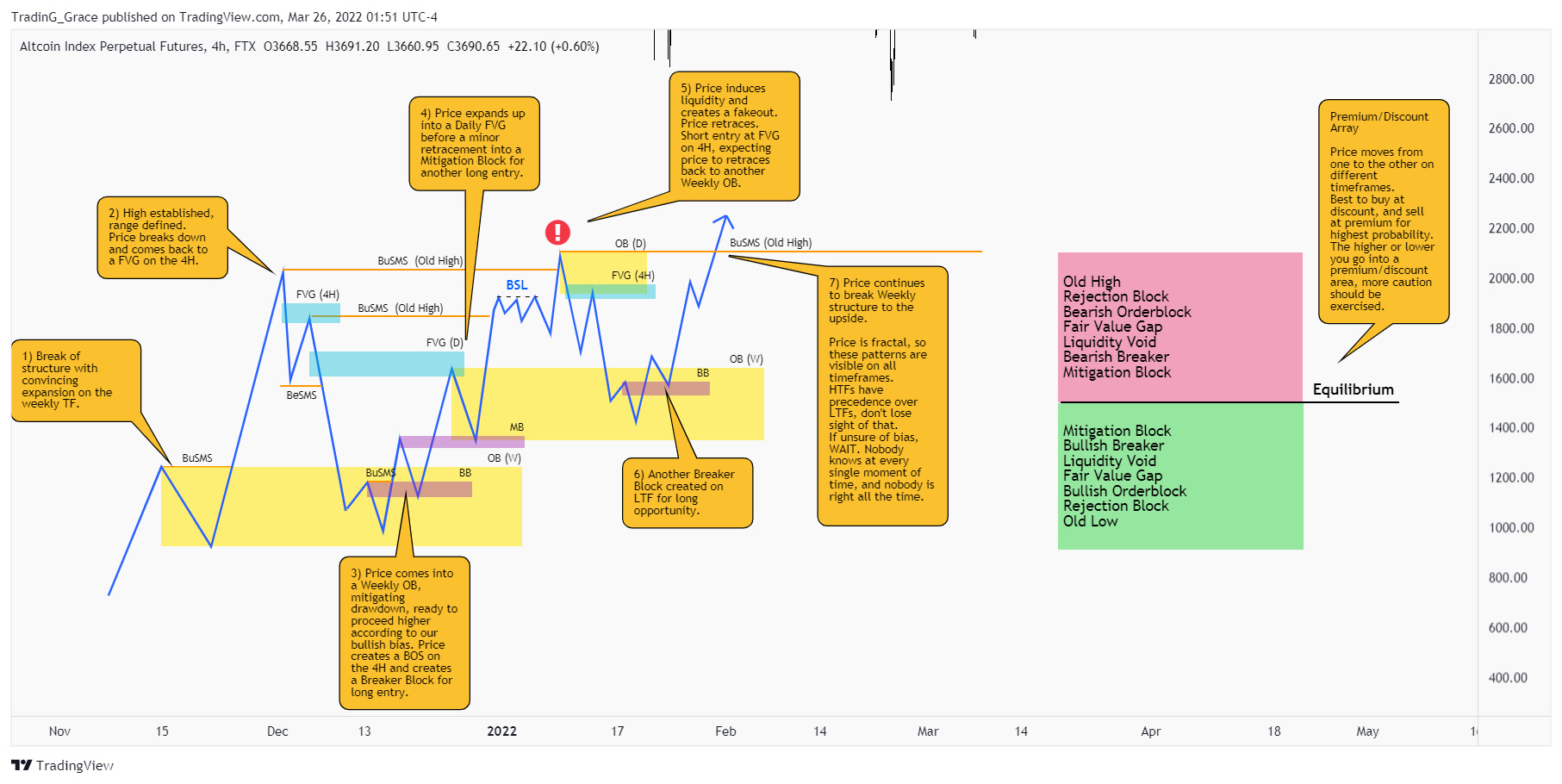
The ICT model works. When it's working, it works with a level of precision that builds genuine conviction. You can identify displacement, Fair Value Gaps, Order Blocks, liquidity grabs, all of it creates a framework that feels like certainty. And that certainty is largely earned through screen time and backtesting.
But here's the problem: high-conviction models make losses feel personal in a way that low-conviction approaches don't. If you're a discretionary trader with a loose strategy, a loss is just 'the market was choppy.' When you've identified a textbook FVG at a premium-to-discount flip zone, with confluence from a Weekly SIBI, during a session where you anticipated institutional accumulation, and it still stops you out, it doesn't feel like a statistical outcome. It feels like a personal failure. Like your read of the market was wrong. Like you are wrong.
That's the trap ICT traders fall into more often than traders using simpler systems. The sophistication of the model raises the emotional stakes of every loss.
I've seen this pattern repeatedly: the trader who obsessively marks every FVG, OB, and liquidity void on three timeframes, builds a flawless top-down narrative, then takes a valid 1R loss and immediately goes back in with 3% risk to 'recover it.' The setup degraded the moment they re-entered. They weren't trading the chart anymore. They were trading their ego.
A Worked Example
Picture GBPUSD on the 15-minute chart. The London open prints a clean displacement candle through the Asian session high, leaving a well-defined FVG. Higher timeframe context is bullish: price swept weekly sell-side liquidity a couple of days earlier and is in the early stages of a move higher. The long goes in inside the FVG, with the stop below the gap and the swing low that started the displacement, because if price trades back under that, the bullish read is wrong. The target is the next buy-side liquidity above. Textbook setup. Clean entry.
Price moves into the FVG, stalls, and reverses. Stopped out.
Here's the reaction to watch for: it often isn't frustration. It's closer to embarrassment. The setup was so clean that the loss feels like being publicly wrong, even with no audience. That quiet, hot shame is exactly where the revenge loop wants to start.
The move is to recognize it, close the chart, and write one sentence in your journal: "Valid setup, valid loss, sample size is not one." Then stay off the platform for a while.
That pause is trained, not natural. Most of us have to get it wrong a few times before we understand what we're actually fighting.
The 3-Step Circuit Breaker
This isn't theoretical. These are the three specific actions, in order, that interrupt the shame loop before it converts into a revenge trade. If you skip steps or reorder them, they don't work.
Step 1: Name the Emotion Accurately (Under 60 Seconds)
Not 'I'm frustrated.' Not 'I'm annoyed.' Ask yourself specifically: Am I ashamed of this loss? Psychologists call this affect labeling, and in my experience naming the feeling accurately takes some of the heat out of the moment. You're not just venting. You're doing mental first aid.
Write it down if you can. Even one sentence: "I'm ashamed because I thought this was a perfect setup and it failed." That specificity is what creates the circuit break. Generic journaling ('I feel bad') doesn't produce the same effect.
Step 2: Recategorize the Loss Statistically (Not Emotionally)
This step has a specific format. You're going to pull up your last 20 trades, or your backtest results if you're newer, and find your historical loss rate on similar setups. If, say, your FVG entries on the 15-minute chart during London open win 58% of the time, you have a 42% chance of any single trade losing. That's not failure. That's the model performing exactly as expected.
Write this number down next to the shame sentence from Step 1. It should read something like: "I'm ashamed because I thought this was a perfect setup and it failed. Historical loss rate on this setup: 42%. This trade was within the expected distribution."
You're not gaslighting yourself. You're reinstating the statistical frame that shame erased the moment the trade closed. If you want a starting point for reviewing your position sizing and expected value, the risk calculator on this site can help you ground those numbers concretely.
Step 3: Apply a Hard Re-Entry Rule, Not a Time Rule
Here's where most advice fails. 'Take 15 minutes away from the screen' is a time rule, and time doesn't fix a shame response. What fixes it is a condition-based rule.
Mine: I cannot re-enter the market until I can answer three questions out loud (yes, out loud, it engages a different cognitive process than reading silently):
- What is the current HTF narrative on this pair right now, independent of my last trade?
- Is there a valid setup present based solely on current price action, not on recovering my loss?
- If this next trade also loses, what specifically will I do?
If you can't answer all three cleanly, you're still in the loop. The third question is the most important, because revenge trading fundamentally cannot tolerate the idea of another loss. If answering that question produces panic or a blank mind, your nervous system has not reset.
This three-step process can take a few minutes or a lot longer, depending on how deep the shame loop ran. That's the real 'break', not the clock, but your cognitive state.
The Archetype I See Constantly
There's a specific trader profile that revenge trades more than any other: the technically excellent, analytically thorough trader who has very little tolerance for being wrong. They've done the work. They understand premium and discount. Their top-down analysis is genuinely strong. But because their process is so rigorous, every loss carries an implicit question they can't sit with, 'If I did everything right and still lost, what does that mean?'
That question is dangerous. And the market has no obligation to validate even a perfect process on every single trade.
This is exactly the psychology behind many funded account failures, the trader wasn't underprepared. They were over-invested in being right. If you want to understand the mechanical side of how this plays out in funded challenges specifically, the breakdown in 7 fatal mistakes that kill your funded account challenge success is worth reading alongside this piece.
The antidote isn't becoming less rigorous. It's decoupling your identity from any single trade outcome, which is genuinely hard to do if your model has trained you to expect precision. Also worth considering: the Q2 2026 environment has added extra pressure here. If your ICT setups have been behaving unexpectedly this quarter, you're not alone, market structure shifts in Q2 2026 have caught a lot of experienced traders off guard, which only amplifies the shame response when good setups don't follow through.
One Thing Nobody Tells You About Consistency
Actual consistency in trading, the kind that shows up in a funded account's equity curve, isn't about hitting every trade perfectly. It's about your worst behavior. Your worst trade, in your worst moment, under your worst emotional conditions. That's the number that determines your long-term outcome.
You can have 40 disciplined trades and one revenge session that wipes the lot. The results that matter over time come from protecting the floor, not chasing the ceiling.
I used to get this completely backwards. Early in my career, I measured success by the best trades, the 5R runners, the clean sweeps, the entries that hit to the pip. I ignored the revenge trades as 'outliers.' They weren't outliers. They were the most honest data about where my real weaknesses lived.
Where to Go From Here
If you're still early in building your psychological framework around ICT concepts, the crash course gives you the foundational context that makes everything in this article click faster. If you want to go deeper on the mental side specifically, including how to build the condition-based rules that work for your psychology rather than a generic template, the coaching plans break down the different levels of support available depending on where you are in your trading development.
The revenge trade loop is breakable. But it requires you to stop treating willpower as a tool and start treating your emotional state as data, the same way you treat price action. Read the shame signal. Recalibrate. Then trade the chart that's actually in front of you, not the one you needed to be right about.
That shift alone is worth more than any new setup.
Harvest Wright
ICT Trading Coach · 10+ Years Experience
Harvest specializes in ICT methodology and has helped traders pass prop firm challenges, develop consistent strategies, and build the psychology needed for long-term profitability.
Book a Free Discovery Call →Ready to Get Funded?
1-on-1 ICT coaching built around prop firm rules, from a trader who has passed an FTMO Challenge.
Book a Free Discovery CallFree ICT Funded-Trader Playbook
The setups, the pre-trade checklist, and the risk rules I use. Get it free.