
Why Winning Trades Feel Worse Than Losing
Here's the kind of trade I mean, and it's a winner.
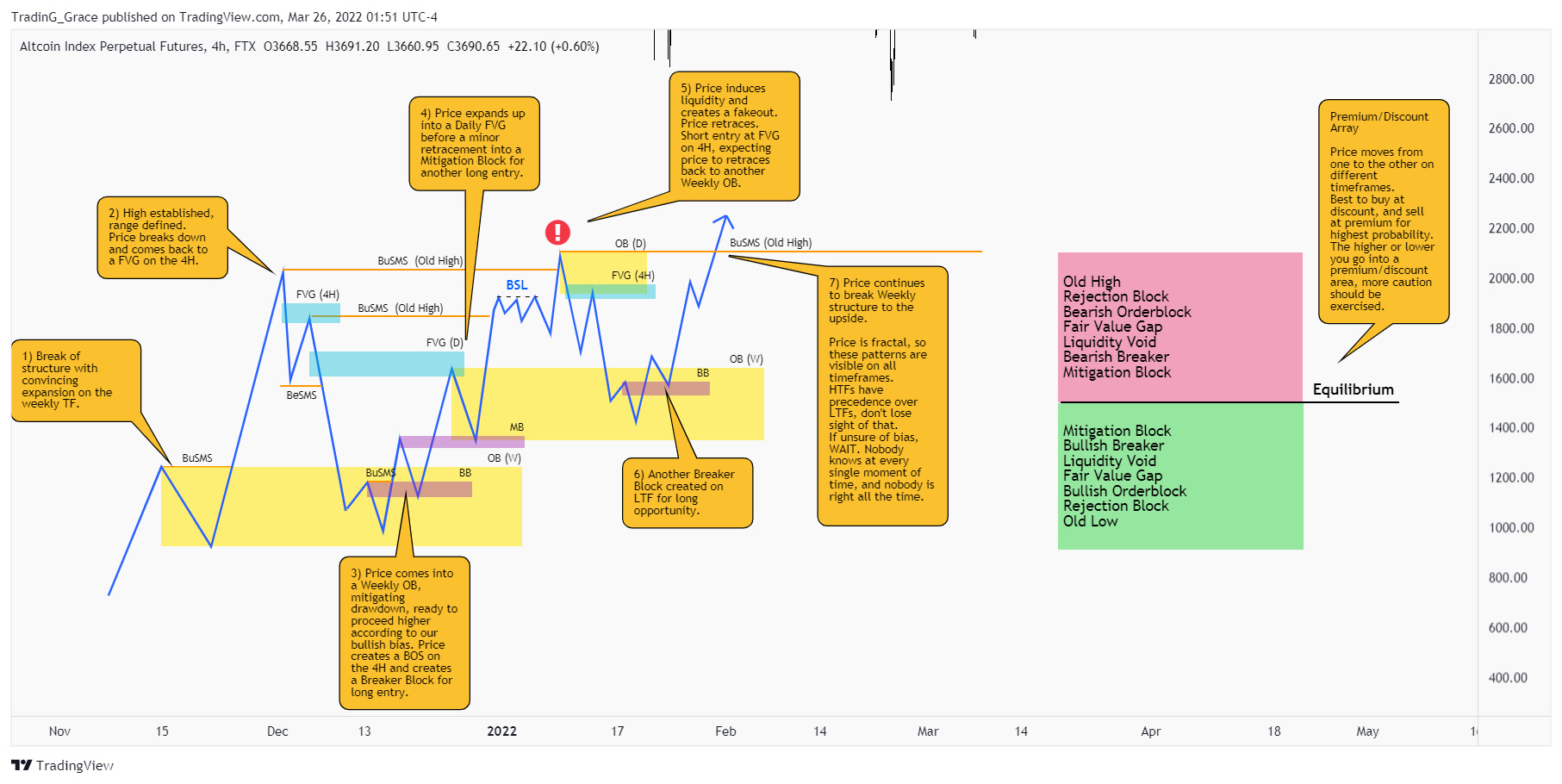
Picture GBPUSD on the 15-minute chart. The London open displacement sweeps a clean set of equal lows sitting above a daily FVG that has been open for a few sessions. The entry goes in on the 15m order block retracement, with the stop below the sweep low, because if price trades back under it the bullish idea is wrong. The target is the buy-side liquidity above. The trade moves immediately and runs well into profit, nearly to target.
And the trader closes it early.
The model didn't say to. They just felt wrong holding it.
Key Takeaway: A big reason funded trader challenges fall apart late in the challenge is profit aversion: the discomfort of sitting in a winning trade that causes traders to exit early, second-guess valid setups mid-run, and unconsciously self-sabotage when success is within reach.
The Problem Nobody in the ICT Space Talks About
Every trading psychology book, every YouTube video, every forum thread, they all say the same thing: traders lose because they can't handle losses. Fear of losing. Loss aversion. Emotional stops. That narrative is so dominant that an entire industry of "discipline" coaching has been built around it.
Here's what 10+ years working with ICT-based strategies has shown me: that narrative is incomplete, and for a very specific type of trader, it's actively harmful.
The traders who make it past the early phases of a funded account challenge, traders who've clearly done the work, who understand CISD and FVGs and liquidity, who can read a premium/discount array without thinking twice, those traders aren't failing because they can't take a loss. They're failing because they can't hold a winner.
Profit aversion. It doesn't have a catchy name yet. It doesn't get the same airtime. But in my experience, it's behind a lot of prop firm attempts that fall apart late in the challenge.
And the brutal irony? ICT's precision-based framework, the very thing that makes this methodology so powerful, accidentally makes profit aversion worse.
Why ICT Actually Makes This Harder
Think about what ICT gives you. HTF PD arrays. OBs. FVGs. Liquidity voids. Fibonacci retracements to the 0.62 and 0.79. Multiple draw-on-liquidity targets. Killzone timing models. Internal range liquidity versus external range liquidity.
All of that is genuinely valuable. But here's what nobody tells you: the more tools you have to justify an early exit, the more exits you'll take.
A trader sitting in a 2R winner on EURUSD with a 4R target doesn't just feel the urge to close early. They have a reason. There's a 4H FVG overhead. There's a potential OB from Tuesday's NY session that price hasn't tapped. There's a swing high with equal highs sitting just below the target. ICT's framework hands you a menu of technically valid reasons to get out before the trade completes, and your nervous system will grab the first one that arrives when discomfort peaks.
Conventional retail trading, pure support/resistance, basic chart patterns, gives you fewer tools, which means fewer exits. That sounds like a weakness. For profit aversion? It's accidentally a feature.
This is the nuance that most ICT YouTube creators miss entirely. They teach the model. They don't teach you that internalizing the model creates a new psychological trap if you're predisposed to profit aversion.
The Archetype I See Over and Over
There's a recognizable pattern I see in funded challenge threads, Discord communities, and prop firm result-sharing forums. Call it the Almost-Funded Trader.
They're technically competent. Often more competent than traders who passed. They identify the setup correctly. They enter with proper risk. The trade runs. And then, somewhere between 1.5R and 2.5R, something shifts. The justifications start. "I should take partials here, this OB is overhead." "The spread's widening, something's wrong." "I'm up 7% on the challenge, I don't want to give it back."
They exit. The trade hits the original target without them.
The next setup appears. They hesitate, because the last trade 'should have been closed sooner' even though it wasn't. Now they're in their head on the entry. They either miss it or size down so aggressively that even a full winner barely moves the needle.
This is the cycle. Not a single catastrophic loss. Death by a thousand rational-sounding decisions.
The cruel part is that from the outside, and even from the inside, this doesn't look like a psychological problem. It looks like prudent risk management. It feels like discipline. It is not.
What's Actually Happening
Behavioral economists like Daniel Kahneman made loss aversion famous: losses hurt more than equivalent gains feel good. Here's how I think it plays out in a winning trade. Once you're in profit, your brain starts treating that open profit as something you already own. So the chance of giving it back starts to feel like a loss.
In other words: sitting in a big winner while your brain screams "you could lose this" can feel a lot like sitting in a loser. Your body doesn't care that you're green. It cares that you could become red.
For a funded trader specifically, add the overlay of what the target means. This isn't just profit. Passing this challenge means becoming funded. That amplifies the pressure, which is exactly why the self-sabotage accelerates as you get closer to the finish line, not further away.
You haven't been getting worse at trading. Your threat response has been getting louder as the stakes feel higher.
The Metric That Exposes It
A lot of traders who think they're conservative, with tight risk management, are really profit-averse traders with a sophisticated vocabulary for cutting winners short.
The way to find out is to track not just win rate and RR, but expected RR versus realized RR. What is your model actually offering you, and what are you actually collecting?
For a profit-averse trader, the gap is usually embarrassing. The model keeps identifying trades that reach their targets, and the realized exits keep landing well short, each one justified with a technical-sounding reason that was really emotional.
Once you see that gap, you can't unsee it. If you haven't run this analysis on your own journal, stop reading and go do it. That number will tell you more about your actual psychology than any assessment.
A Practical Framework for Sitting in Winners
This isn't about willpower. Telling yourself to "just hold the trade" doesn't work, your threat response is faster and louder than your rational mind. You need structural interventions that remove the decision-making from peak discomfort.
Step 1: Pre-define your full exit before entry. Not a target zone. A specific price. Write it down before you click the button. "This trade exits at X or at the original stop. Nothing in between unless price closes beyond a HTF structure level on the 1H." The rule has to be written before the trade is live.
Step 2: Separate partials from emotional exits structurally. If your model calls for partials (and sometimes it should), those partials need a rule attached to a price, not a feeling. "First partial at 1R when price taps the 4H FVG" is structural. "Partial here because I'm nervous" is emotional. These look identical in the moment. They're not.
Step 3: Track your gap metric. Log every trade with both your model's expected target and your actual exit. After 20 trades, calculate the average gap. This number becomes your accountability metric, not just your win rate or your RR.
Step 4: Identify your peak discomfort price. For most traders, the worst feeling in a winning trade arrives at a specific point, often near a round number, a prior swing high, or when floating profit hits a number that means something (like the amount needed to pass the challenge). Mark that level on your chart before entry. Knowing in advance where you'll feel the urge to exit makes it easier to observe the urge without acting on it.
Step 5: Don't monitor open trades past your decision point. If your entry is on a 15m setup and you've defined your exit, you do not need to watch the 1m tick-by-tick. Screen time during open trades is fuel for your threat response. Set alerts. Walk away if your process allows it.
This connects directly to a broader issue I wrote about in 7 fatal mistakes that kill your funded account challenge success, overmonitoring is its own form of self-sabotage that most traders don't classify as a mistake at all.
The Finish-Line Problem Is Real
If you've ever been close to passing a funded account challenge and felt something shift, not technically, but internally, you're not imagining it. The stakes changing your perception is real, and it's more than a mindset weakness to push through with better habits.
In my experience, the traders who pass aren't the ones who feel less pressure. They're the ones who have built structural processes that function regardless of how they feel. The trade execution doesn't ask for your emotional state. The rule either triggers or it doesn't.
For more on what actually separates traders who get funded from those who perpetually reset, the truth about funded trading what they don't tell you covers the prop firm side of this equation in detail. And for how changing market conditions add extra noise, why Q2 2026 market structure shifts are breaking traditional ICT setups is worth reading alongside this.
The Uncomfortable Truth
Most trading content is designed to make you feel like you just need to learn one more concept, identify one more confirmation, build one more rule into your model. Technical content is easier to sell than psychological work because it feels more actionable.
But if your gap metric is wide, if you're consistently identifying 3R setups and walking away with 1.4R, no additional ICT concept is going to fix that. The model isn't the problem.
You are holding yourself to a ceiling that is below what the market is already offering you.
Recognizing profit aversion as a real problem, separate from discipline or technical gaps, is the first step toward actually removing it. The gap metric is the second. The structural process framework is the third.
If you want help building that process around your specific model and challenge parameters, the coaching plans page breaks down exactly how we work through this, from Lite at $150/week up through Full Mentorship. Or if you want to figure out whether coaching makes sense before committing, book a free discovery call and we can look at your journal together.
The market will keep offering you 3R trades. The question is whether you'll finally let yourself take them.
Harvest Wright
ICT Trading Coach · 10+ Years Experience
Harvest specializes in ICT methodology and has helped traders pass prop firm challenges, develop consistent strategies, and build the psychology needed for long-term profitability.
Book a Free Discovery Call →Ready to Get Funded?
1-on-1 ICT coaching built around prop firm rules, from a trader who has passed an FTMO Challenge.
Book a Free Discovery CallFree ICT Funded-Trader Playbook
The setups, the pre-trade checklist, and the risk rules I use. Get it free.