
Why Winning Trades Still Break Your Mindset
Some of the most dangerous trades are the winners. A clean win at the end of a good run can be the start of a psychological spiral that's hard to see from the inside.
Most content you'll find on trading psychology circles the same drain: how to recover from losses, how to handle drawdowns, how to get back in the saddle after a rough patch. That's important. After 10+ years of trading, though, I think the breakdown that starts with success deserves just as much attention.
Key Takeaway: Consistent winning can quietly wear down your discipline by shifting what feels "normal" in terms of risk. Your risk tolerance creeps upward so gradually that you don't notice it until you've taken damage no single loss should have caused.
A Worked Example
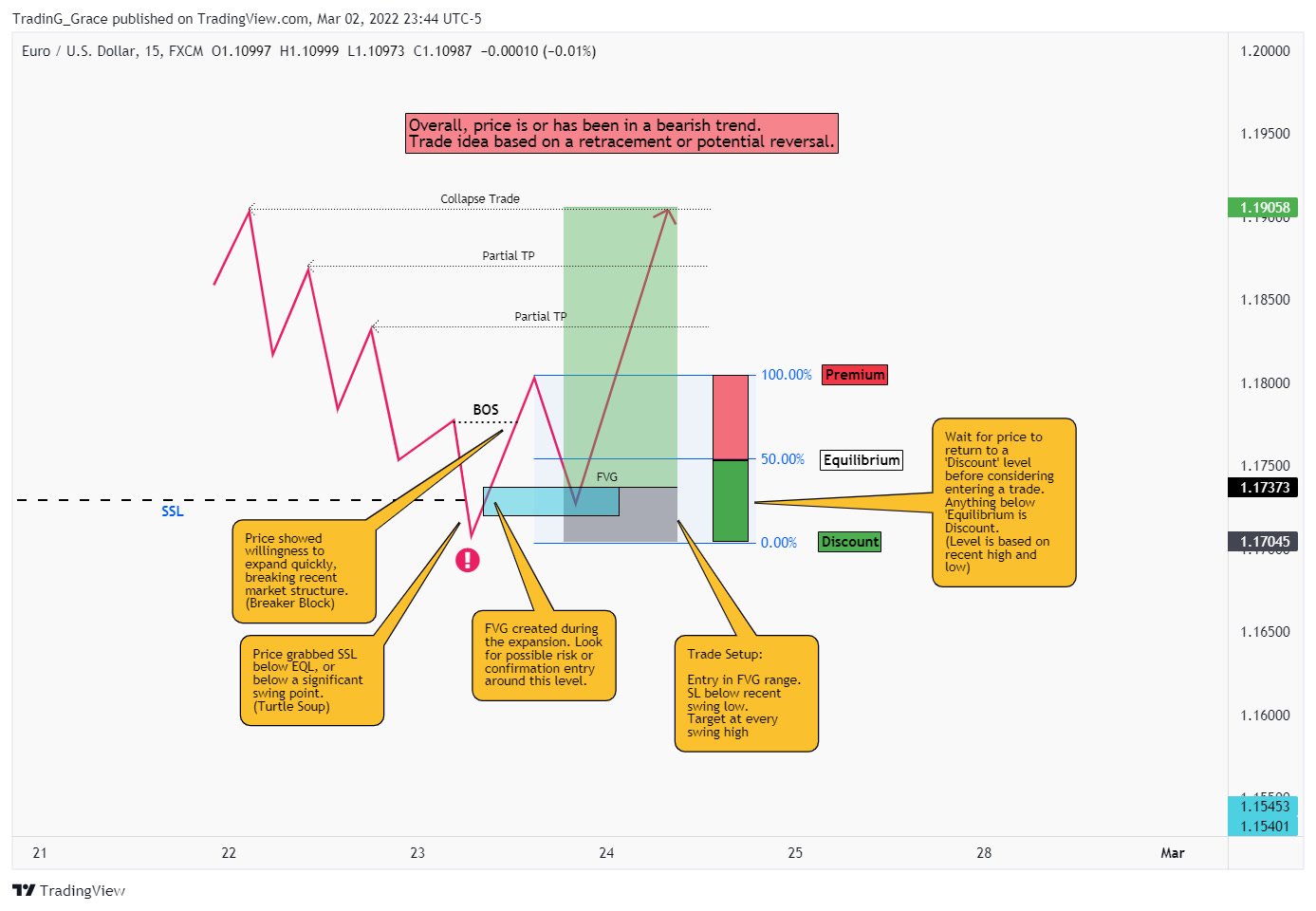
Here's the kind of setup I mean. Picture GBPUSD on the 15-minute chart during the London session. Higher timeframe bias is long. Just before the London open, price sweeps below the previous day's low, taking the sell-side liquidity. Then it displaces up hard and leaves a clean bullish Fair Value Gap. Textbook.
The entry goes in the FVG on the retrace. The stop sits below the sweep low, because if price trades back under it, the idea is wrong. The target is the buy-side liquidity above, like the Asian range high or the previous day's high. The trader risks 0.5% of the account, the same as every setup for months.
It works. Exactly what you'd draw on a whiteboard. And say it's the seventh winner in a row. That's the moment something can shift without the trader noticing.
What a Winning Streak Actually Does to Your Brain
Here's what no one talks about: repeated reward can quietly raise your threshold for what counts as normal risk.
Every time a well-structured ICT setup pays out, your FVG entry held, the OB respected, price swept liquidity and reversed exactly where you said it would, your brain files that not as "the plan worked" but as "I was right." Subtle difference. Massive consequence.
Here's how the creep tends to go. After that seventh win, risk moves from 0.5% to 0.75% on the next setup. "Still conservative." A couple of wins later, it's 1%. Then a "high conviction" setup gets 1.5% because the structure is "too clean to treat like a normal trade."
None of these decisions felt reckless at the time. Each one felt earned.
That's the trap. You're not gambling. You're not abandoning your system. You're incrementally redefining what reasonable risk looks like, and the winning streak is providing the justification at every step. You can run the numbers yourself with a risk calculator and it still won't feel wrong, because the math technically still works at 1.5%. That's what makes it so dangerous.
A little further into the streak, B-minus setups start getting treated like A-plus trades, because the recent track record says the trader's read is sharper than it really is.
Then comes the trade that breaks it. Say a EURUSD short on a 5-minute FVG during a news-adjacent window the trader would normally avoid. There's a narrative, a liquidity sweep, a displacement. What's missing is patience, and the risk is now 2% instead of 0.5%. It stops out.
On its own, that's one loss. The problem is that a couple of other oversized positions are usually open by this point too. When they go against you at the same time, you can give back weeks of normal gains in a couple of days.
Why This Pattern Is So Hard to Spot
A common pattern I see: the trader's actual entries don't get worse. The technical reads are still good and the setups are legitimate on paper. What changes is the size attached to each trade, which quietly doubles, and the tolerance for marginal confirmation, which quietly drops. Entering faster, holding longer and risking more all compound into account damage, and success is what moved the baseline.
This is one of the things I look for when I review a trader's journal in coaching.
The Mechanism Nobody Explains
Conventional trading psychology content tells you overconfidence follows winning. True, but incomplete. What it doesn't explain is how overconfidence actually manifests in ICT-style trading specifically.
It doesn't show up as "I think I can't lose." It shows up as:
Confirmation compression, you start needing fewer confluences to feel confident. Where you once required HTF bias + displacement + FVG + time-of-day alignment, now three out of four feels sufficient. Then two. The threshold drops so gradually you'd never catch it without reviewing your confluence checklist against actual entries.
Narrative inflation, you start constructing more elaborate reasons why a setup qualifies. "Yes the FVG isn't perfectly clean but the OB is strong and there was a liquidity sweep three days ago that probably set this up." Your ability to explain a trade doesn't mean the trade meets the standard. After a winning streak, the explanation gets more sophisticated even as the setup gets weaker.
Size anchoring to recent results, this is the most mechanical of the three. If your last five trades returned 1.8R average on 1% risk, your brain starts treating 1% as the starting point rather than 0.5%. You've accidentally moved the floor.
For a deeper look at how confluence quality should actually be evaluated before entry, I wrote a detailed breakdown in the ICT Fair Value Gap trading checklist that covers exactly this.
A Framework for Catching Yourself Before the Damage
Here's the system I use, and teach, to keep winning streaks from becoming psychological traps.
Step 1: Lock position sizing to a ceiling, not a range. Stop thinking of your risk as "up to 1%." Fix it. 0.5% per trade until you've completed a full 20-trade sample review. The number doesn't get adjusted mid-stream based on feel, momentum, or confidence. You can use the risk calculator to pre-load your sizing before you even look at a chart. Decision made in advance means decision made without emotional contamination.
Step 2: Score your confluence before you see the potential reward. Before drawing a target, before calculating R, go through your checklist. HTF bias confirmed? Yes or no. Displacement present? Yes or no. Entry model within killzone? Yes or no. FVG or OB within a defined premium/discount zone? Yes or no. If you're below your minimum threshold, in my case, four of five criteria, the trade doesn't qualify regardless of how strong the narrative feels. Feeling strong is the warning sign after a winning streak.
Step 3: Flag your psychological state in the journal, not just the trade. At the top of every trade entry, write a single sentence about where your head is. "Feeling confident after last week" is useful data. "Slightly frustrated I missed that AUDUSD setup" is useful data. You're looking for the entries that say "feeling sharp, setup feels obvious", those are the ones to audit hardest. That feeling is not edge. That feeling is the threat.
Step 4: After five consecutive wins, mandatory size reduction for the next three trades. I know this sounds backwards. But a string of five wins is a signal to increase your skepticism, not your confidence. Drop back to 0.25% for three trades. If the setups still work at reduced size, you've confirmed the edge is real rather than momentum-fueled. If you suddenly feel reluctant to trade at 0.25%, that reluctance is telling you everything. This connects directly to a broader truth I explored when writing about the 1% rule that changed everything, fixed risk rules only protect you if you actually follow them when it feels most uncomfortable to do so.
This framework isn't about being timid. It's about recognizing that your psychological state is a variable in every trade, whether you account for it or not. In my experience, experience itself doesn't protect you from overconfidence, because past success gives the bias something to stand on.
What Losing Streaks Can't Teach You
Here's my contrarian take: a bad losing streak is almost easier to recover from psychologically than a winning streak gone wrong.
A loss says: your analysis failed. That's painful, but it points clearly to something, your entry model, your timing, your confluence reading. There's a problem to fix. You go back to basics, you review your trading insights, you audit your setups. The path forward is visible.
A winning-streak-turned-implosion says: your success created the failure. That's disorienting in a way that's genuinely hard to process, because nothing in the usual recovery playbook addresses it. You can't "tighten up your entries" when your entries were fine. You can't "be more patient" when you were patient during the winning streak too. The variable that broke things was invisible, it lived in the gap between your stated risk rules and your actual behavior, and a string of wins quietly pried that gap open.
If any of this sounds familiar and you want to work through it in real-time, not just read about it, I work with traders directly through coaching plans at different levels depending on where you are. Or if you're not sure whether mentorship is what you need right now, book a free discovery call and we'll figure that out together first.
The hardest version of good trading psychology isn't surviving the losses. It's having the self-awareness to stay disciplined when everything is working, when the market is validating every read, when the confidence feels completely justified, when slowing down feels like leaving money on the table.
That's exactly when the most important decision you'll make isn't about entry. It's about staying the same size as yesterday, when yesterday you were already enough.
Harvest Wright
ICT Trading Coach · 10+ Years Experience
Harvest specializes in ICT methodology and has helped traders pass prop firm challenges, develop consistent strategies, and build the psychology needed for long-term profitability.
Book a Free Discovery Call →Master Your Trading Psychology
Psychology is a huge part of trading. Our coaching includes dedicated psychology sessions.
See Coaching PlansFree ICT Funded-Trader Playbook
The setups, the pre-trade checklist, and the risk rules I use. Get it free.